Let's be honest about what this is. This is a pig's large intestine. Its job, until very recently, was to be a large intestine — and it was very good at that job. It processed things. It absorbed things. It did what intestines do, efficiently and without complaint, for the entire life of the pig. Now it's your dinner.
The Western food industry looked at the prep work involved and threw it away. Pet food factories love it. Chinese cooks looked at the exact same ingredient and said: challenge accepted. What follows is what "challenge accepted" actually means, step by step.
1. Stage 0: what you're working with
A raw pork intestine arrives as a long, pale, slightly translucent tube — anywhere from one to one and a half meters of large intestine, folded over itself, still carrying the distinct biological evidence of its previous career. The smell at this stage is not subtle. The texture at this stage is not appealing. The amount of prep work required to fix both of these things is considerable.
This is where most Western food cultures gave up and invented sausage casings instead. This is where Chinese cooking said hold on, we're not done yet.
2. The Great Cleaning: the most important hour in pork intestine history
Cleaning pork intestine properly is an art form. Get it wrong and no amount of spice or braising time will save you. Get it right and you have a blank canvas that absorbs flavor like nothing else in the kitchen. Six steps, in order:
Step 1 — The Turn. The intestine gets turned completely inside out, exposing the inner surface where most of the biological material clings. A chopstick or the handle of a wooden spoon pushed through one end helps. It is not glamorous. Do it anyway.
Step 2 — The Salt and Flour Scrub, Round One. Coarse salt and flour get rubbed aggressively into every surface. The salt draws out moisture and acts as an abrasive; the flour absorbs fat and odor compounds. Rinse thoroughly. The water runs grey. This is correct.
Step 3 — The Vinegar Soak. White vinegar, poured directly onto the intestine and worked in by hand for several minutes. The acidity breaks down the proteins in the remaining odor compounds. The intestine begins to smell significantly less like an intestine and more like vinegar. This is progress.
Step 4 — The Salt and Flour Scrub, Round Two. Yes, again. Same process, different result: this time the water runs clearer, the smell is almost neutral, and the texture shifts from slippery to something that will actually hold a braise.
Step 5 — The Turn Back. The intestine gets turned right-side out again. The outer surface gets its own quick scrub. More rinsing.
Step 6 — The Inspection. Hold it up to the light. The wall of a properly cleaned intestine should be pale, almost translucent, with no remaining dark patches or suspicious residue. If it passes: proceed. If it doesn't: go back to Step 2.
Total cleaning time: 45 minutes to an hour, minimum. This is the step that separates great fèicháng from mediocre fèicháng. Restaurants that cut corners here produce dishes that taste like they cut corners. There are no shortcuts. The intestine knows.
3. The Blanch: locking in the structure
Clean intestine goes into cold water, brought to a boil with ginger, scallions, and Shaoxing wine. This does three things simultaneously. One: it removes any remaining impurities the scrubbing missed. Two: it begins to set the collagen in the intestine wall — the same transformation that happens in trotters and chicken feet, just faster, because the walls are thinner. Three: it starts building the texture.
That texture is what Chinese food culture calls 脆Q — "Q" for short: a satisfying resistance that gives way cleanly rather than being rubbery or mushy. A properly blanched intestine firms up slightly on the outside while staying yielding inside. And the blanching water gets discarded. Every time. No exceptions.
4. The Slow Path: the braise (卤肥肠)
For braised fèicháng, the cleaned, blanched intestine goes into a master stock built from dark and light soy sauce for color and salt, rock sugar for the lacquered finish, Shaoxing wine for depth, and star anise, cinnamon, bay leaves, Sichuan peppercorns, dried chilies, cloves, and dried tangerine peel for the aromatic architecture. Low heat. Long time. Minimum ninety minutes, ideally two hours.
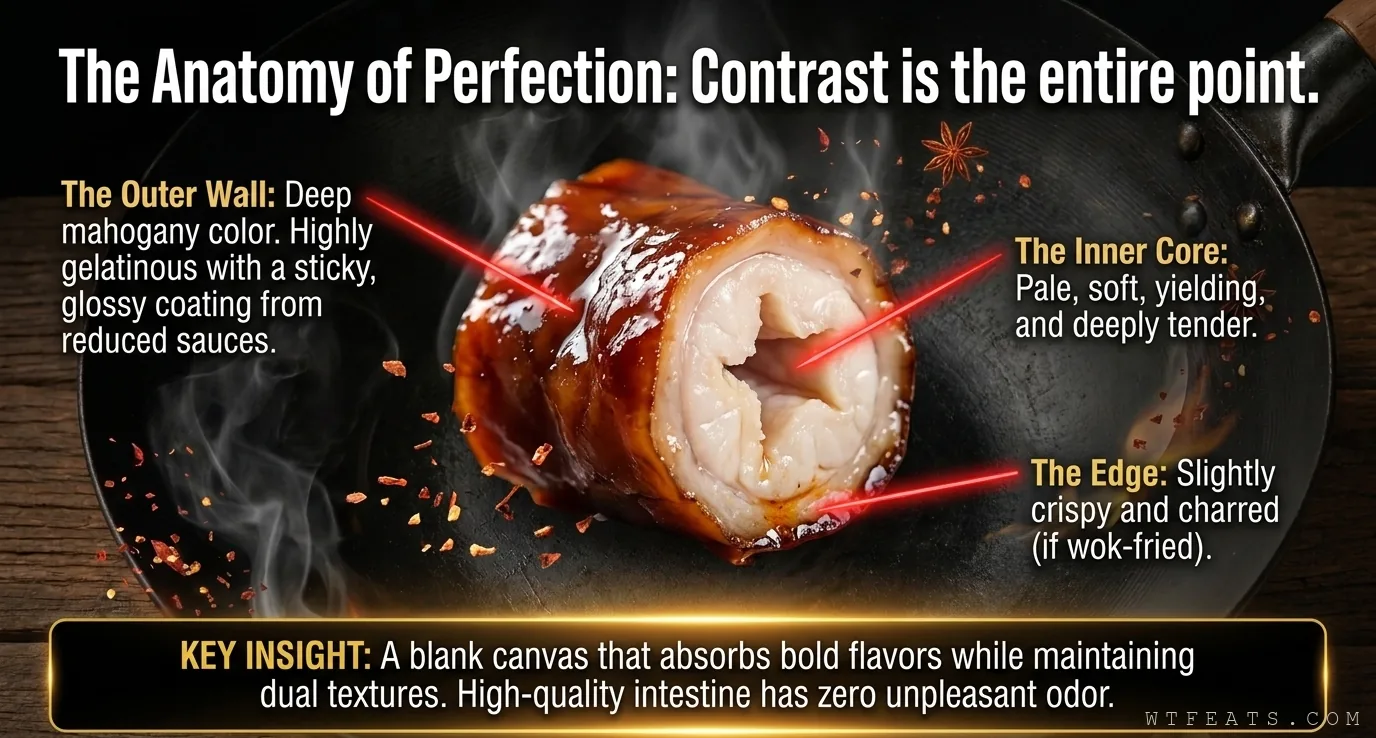
During this time the collagen in the intestine wall finishes its conversion to gelatin. The outer surface takes on a deep mahogany color and a glossy, slightly sticky coating from the reduced braising liquid, while the interior stays soft and yielding. Cut it on the diagonal — the standard three-centimeter section — and the cross-section reveals a ring of deeply colored, gelatinous outer wall around a tender, pale interior. The two textures are distinct. The contrast is the point.
5. The Fast Path: the stir-fry (爆炒肥肠)
This is the harder technique. Significantly harder. 爆炒 — "explosive stir-fry" — requires a wok at temperatures most domestic stoves cannot reach. Professional wok burners in Chinese restaurants run at 50,000 to 150,000 BTU. A standard home gas stove runs at 7,000 to 12,000 BTU. This is not a small difference. This is the difference between a stir-fry and a steam.
The technique: pre-blanched intestine sections hit the wok in a single layer, in oil that is already smoking. The contact is immediate and violent. Within seconds the outer surface caramelizes — the Maillard reaction happening fast, creating a slightly charred, crispy exterior that contrasts completely with the soft interior. Then doubanjiang (fermented chili bean paste), garlic, ginger, dried chilies, and Sichuan peppercorns go in, in rapid succession, each one sizzling and releasing its compounds into the wok in the space of thirty seconds. Green peppers or leeks go in last. Twenty seconds. Out. Total wok time: under three minutes.
The result: intestine sections that are simultaneously charred on the outside, tender on the inside, numbing, spicy, fragrant, and deeply savory — a combination that took forty-five minutes of cleaning and two minutes of extremely high-temperature cooking to achieve. This is why restaurant fèicháng tastes different from home fèicháng. You can approximate the heat — cast iron pan, highest setting, small batches — but you are approximating. The real thing requires fire.
What the West turned into pet food, Chinese cuisine turned into a technical exam — and every shortcut shows up on the plate.
6. The Regional Split
Once you have clean, properly prepared fèicháng, China splits into factions about what to do with it. Sichuan: 爆炒肥肠 — explosive stir-fry with doubanjiang and Sichuan peppercorns; numbing, spicy, charred edges, served over rice or noodles. Hunan: 辣炒肥肠 — similar concept, different chili profile; fresher, greener, sharper heat without the numbing. Beijing: 卤煮火烧 — braised intestine slow-cooked with pork lung and tofu in a soy-heavy master stock, served with flatbread torn into the broth; street food royalty. Guangdong: 猪肠粉 — intestine inside rice noodle rolls, dim sum style; delicate, steamed, served with sweet soy. Taiwan: 大肠包小肠 — pork intestine sausage inside a sticky rice "bun" that is itself made from a larger sausage casing. A sausage inside a sausage. The Taiwanese did not come to play.
Same ingredient. Five completely different directions. All of them correct.
7. The numbers
- 45 minutes minimum cleaning time — no shortcuts, no exceptions.
- 3 rounds of scrubbing before the intestine is ready to cook.
- 150,000 BTU — the wok heat a professional kitchen uses that your stove cannot match.
- 3 minutes — total wok time for 爆炒肥肠 after 45 minutes of prep.
- 5 regional versions — same ingredient, completely different outcomes.
- 0 — the number of steps in the cleaning process you can skip.
The verdict
Pork intestine is the ingredient that tells you everything about a cook's standards. The cleaning cannot be faked. The blanching cannot be rushed. The wok heat cannot be approximated. What the West threw away, Chinese cuisine turned into a dish that rewards patience, precision, and the willingness to spend forty-five minutes cleaning something before you even think about applying heat. The intestine was always the point. You just had to be willing to clean it first.
And if the collagen-to-gelatin transformation at the heart of this craft sounds familiar, it should: our Pork Trotters chapter runs the same conversion on a much larger animal part. Same conversion, thinner walls, faster clock.