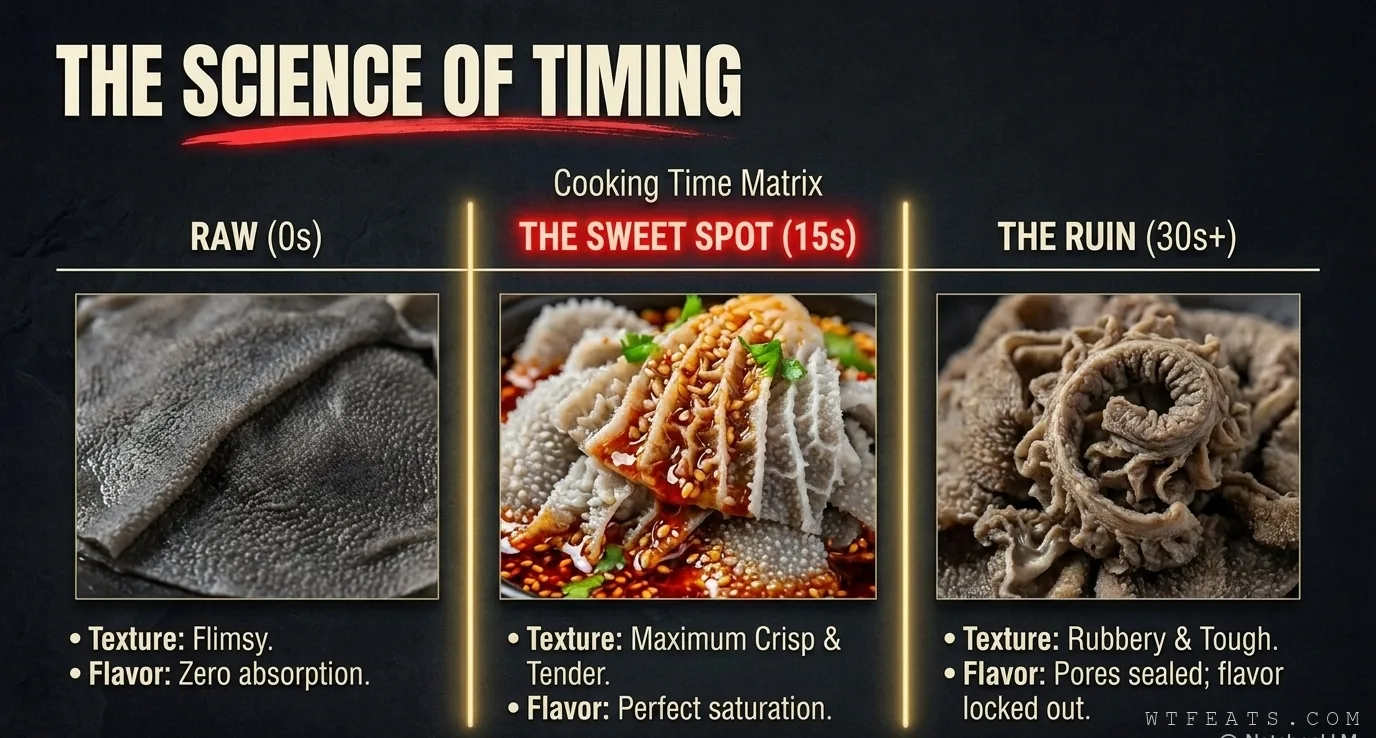
Let's be honest about what this is. This is a cow's stomach — specifically the third one. Beef omasum, known in Chinese as máo dù (毛肚), is one of the most famous ingredients in Chinese hot pot, especially in Sichuan and Chongqing cuisine. Many international diners simply call it beef tripe, but máo dù refers to one specific chamber: the omasum, with a distinctive layered structure and honeycomb-like folds that make it ideal for hot pot.
And here is the twist: unlike fatty meats, máo dù has a very mild flavor. Its popularity comes from its texture. For many Chinese food lovers, no authentic hot pot meal is complete without fresh máo dù — and the craft of it runs from anatomy to stopwatch.
1. Stage 0: what you're working with
A cow has multiple stomach chambers, and "tripe" could come from more than one of them. Máo dù is specific: the omasum, the third chamber. Fresh máo dù is dark gray to black, built from thin, leaf-like layers covered in tiny textured ridges. When cooked, it becomes slightly lighter in color while keeping its distinctive folded appearance.
The texture looks delicate yet firm — and those hundreds of tiny folds are not decoration. They are designed, by anatomy, to absorb flavorful broth. That single fact explains everything else in this article.
2. The flavor profile: engineered for mouthfeel
If you are coming to máo dù for a strong, beefy taste, recalibrate. Its own flavor is very mild. What it delivers instead is a texture profile that hot pot culture treats as the main event:
- Crisp — the signature bite, non-negotiable.
- Tender — yielding, never stringy, when timed right.
- Slightly chewy — a satisfying resistance, not a workout.
- Juicy after cooking — the folds arrive loaded with broth.
- Light and refreshing — rich meal, clean finish.
When dipped into spicy Sichuan hot pot broth, máo dù absorbs the rich aromas of chili, garlic, and Sichuan peppercorns while retaining its signature crunch. The mildness is the feature: the ingredient is a texture machine, and the broth is its fuel. Texture is considered more important than flavor — máo dù is where that philosophy becomes literal.
3. The preparation protocol: purity, precision, freshness
Preparing fresh máo dù requires careful cleaning and trimming — and then, unusually, almost no cooking at all. Three steps, in order:
Step 1 — Cleaning. The omasum is washed thoroughly to remove impurities while preserving its natural layered texture. The goal is purity without damage: those folds are the whole product, and rough handling that flattens them ruins the absorption mechanics.
Step 2 — Slicing. It is cut into thin sheets that cook quickly. Thin is not an aesthetic choice — it is a thermal one. A thin sheet heats through evenly in seconds, which is what makes a ten-to-fifteen-second cook possible at all.
Step 3 — Serving fresh. Unlike many other cuts of meat, máo dù is usually served raw and cooked directly at the dining table in hot pot. In restaurants, it is often beautifully arranged on large white plates, the layers spread out like flower petals — typically alongside fresh vegetables, mushrooms, tofu, thinly sliced beef, chili dipping sauce, and sesame oil. The kitchen's job ends at the plate. What happens next belongs to the diner.
4. The law of the broth: Seven Up, Eight Down
One famous Sichuan saying governs the entire transaction: 七上八下 — "Seven Up, Eight Down." Diners quickly dip the máo dù into boiling hot pot broth for about ten to fifteen seconds, moving it up and down several times.
The rhythm matters. The up-and-down motion keeps heat even across every fold — no section of the sheet lingers in the hottest zone long enough to toughen while another stays raw. The result of proper timing: máo dù that stays crisp and tender. The result of ignoring it: overcooking makes it tough. Many hot pot lovers believe perfectly cooked máo dù should be crisp but never rubbery, and the entire difference between those two outcomes is a handful of seconds.
Crisp is everything. Rubbery is ruin. The law is Seven Up, Eight Down — and the clock is always running.
5. The catalyst: the dipping sauce
Straight from the broth, the slice lands in the dip. Máo dù is commonly dipped into sesame oil, garlic sauce, chili oil, soy sauce, and vinegar — combined to taste. The sesame oil does double duty: it cools the scalding piece on contact and coats the folds so the broth's aroma survives the trip to your mouth. Garlic cuts through the richness. Chili oil, soy sauce, and vinegar tune the bite in whichever direction you want. The dip enhances; it never replaces. The crunch stays in charge.
6. The boiling point of culture
Máo dù has become one of the defining ingredients of Sichuan and Chongqing hot pot culture. Friends and families gather around a bubbling hot pot, cooking ingredients together while sharing conversation — and within that ritual, máo dù plays a special role. The ritual of timing máo dù perfectly is considered part of the hot pot experience, and many experienced diners proudly demonstrate the ideal cooking technique. It is one of the most popular hot pot ingredients in Sichuan and Chongqing precisely because it turns dinner into a small public performance: everyone can see your chopsticks, and everyone can see your timing.
Today, máo dù is served in thousands of hot pot restaurants across China and has become increasingly popular in Chinese restaurants around the world.
7. The numbers
- 3rd — the stomach chamber máo dù comes from: the omasum.
- 10–15 seconds — the Seven Up, Eight Down sweet spot in boiling broth.
- <20 seconds — total cooking time, start to finish.
- 5 — classic dip components: sesame oil, garlic sauce, chili oil, soy sauce, vinegar.
- 1,000s — hot pot restaurants across China serving máo dù today.
- 0 — tolerance for overcooking. Tough is forever.
The verdict
Máo dù is the ingredient that tells you everything about a diner's attention span. The anatomy cannot be faked — only the third chamber has those folds. The timing cannot be delegated — the cook at a hot pot table is you. What other cuisines might overlook, Sichuan and Chongqing turned into the crunch at the center of the table: mild in flavor, absolute in texture, and governed by a fifteen-second law that everyone at the pot can see you obey or break. The stomach was always the point. You just had to count while you cooked it.
And if a texture-first offal craft sounds familiar, it should: our Pork Intestine chapter runs the same obsession with Q and crunch on a very different organ — 45 minutes of cleaning there, 15 seconds of dipping here. Same family of textures, opposite clocks.