Let's be honest about what this is. This is an insect that spent between 2 and 17 years underground, attached to tree roots, feeding exclusively on xylem fluid — the nutrient-rich sap that flows through those roots. It did this slowly, patiently, with extraordinary efficiency, molting several times, growing larger with each cycle, accumulating protein and fat with the single-minded focus of an athlete in training. Its entire biological purpose during this time was to prepare for one brief emergence above ground, one transformation into an adult cicada, and one reproductive cycle. In Shandong, someone with a flashlight had other plans.
The reason cicada nymphs taste the way they do is directly connected to the years they spent not being food. Understanding that connection is the key to understanding why this snack is genuinely, chemically interesting — and why people who try them once become people who wait for cicada season every year.
1. The 17-year setup: what the nymph has been building
A cicada begins its life as an egg, laid in a tree branch by its mother. When the egg hatches, the tiny nymph drops to the ground and immediately burrows into the soil. And then it waits. For years.
While underground, the nymph feeds exclusively on xylem fluid. This is a slow, patient form of nutrition extraction — xylem fluid is not nutrient-dense, so the nymph processes enormous quantities of it over years, extracting what it needs and accumulating the rest. With each molt, the nymph grows larger, and with each growth cycle, it packs more protein and fat into its abdomen. By the time it emerges, triggered by soil temperature reaching exactly 17°C, the nymph is essentially a protein and fat delivery system wrapped in an exoskeleton.
Its body is dense. Its abdomen is packed with nutritional reserves it has spent years building up for the final push to the surface and the transformation into an adult cicada. It emerges at night. It climbs the nearest tree. It begins to shed its exoskeleton. And in Shandong, someone is waiting with a flashlight and a bucket.
2. The harvest window: brutally short, non-negotiable
The cicada nymph is only available for a brutally short window: late June to early August in most of northern China, with peak season lasting perhaps three to four weeks. The harvest happens at night — specifically in the two to three hours after sunset, when the nymphs emerge from their exit holes in the soil and begin their climb.
Experienced collectors know the signs: small circular holes in the soil around the base of trees, appearing suddenly as soil temperatures rise. Each hole is a nymph in transit. The collection method is ancient and unchanged: flashlight in one hand, container in the other, moving through orchards and forests in the dark. A skilled collector can gather hundreds of nymphs in a single night.
The window between emergence and exoskeleton-shedding is approximately two to four hours. After that, the nymph splits its back, the adult cicada begins to emerge, and the culinary moment has passed. The exoskeleton hardens. The texture changes. The fat content redistributes. Timing is everything. The nymph must be collected before it sheds. This is non-negotiable.
3. The prep: deceptively simple
Compared to pork intestine or tripe, cicada nymph preparation is almost insultingly straightforward. But the simplicity is deceptive.
Step 1 — The Purge. Fresh nymphs go into lightly salted water for several hours — sometimes overnight. This serves two purposes: it cleans the digestive tract (the nymph, after all, has been eating tree root sap for years and carries evidence of this), and it firms up the body slightly, preparing it for cooking.
Step 2 — The Dry. Out of the water, patted dry. Moisture is the enemy of a good fry. Any remaining water on the surface will cause violent splattering when the nymph hits the oil and will prevent the exoskeleton from crisping properly.
Step 3 — The Optional Salt. Some cooks add a light sprinkle of salt at this stage. Some add nothing. The nymph brings enough flavor on its own that heavy seasoning is unnecessary — the goal is to enhance, not to cover. That's it. Three steps, no specialist equipment, no hour-long cleaning process. What looks like a minimal-effort ingredient is actually doing all the work itself — seventeen years of work, to be precise.
4. The fry: where science happens in three minutes
Oil temperature: 180 to 190°C. Not lower. Not higher.
Lower than 180°C: the exoskeleton absorbs oil rather than crisping. The interior steams rather than fries. The result is greasy and soft — a failure state. Higher than 190°C: the exoskeleton burns before the interior is cooked through. The proteins in the abdomen don't have time to set properly. Another failure state.
180 to 190°C is the window. A thermometer is not optional. The nymphs go in — not too many at once, because crowding drops the oil temperature and you're back in failure state territory. They hit the oil and immediately begin the transformation:
Seconds 1–30: The surface moisture flash-evaporates. The exoskeleton begins to set. Color starts shifting from pale cream-brown to golden.
Seconds 30–90: The proteins in the abdomen begin to cook through. The fat content — accumulated over years of feeding on tree root sap — begins to render slightly, basting the interior from within. The exoskeleton continues darkening toward deep gold.
Seconds 90–180: Full transformation. The exoskeleton is now crispy — genuinely, structurally crispy in a way that shatters rather than bends when you bite it. The abdomen interior has set into a dense, rich, slightly creamy paste. The color is deep amber-gold. The smell is extraordinary — nutty, rich, with a faint sweetness from the rendered fat.
Out. Drain. Salt immediately. Total fry time: three minutes. Seventeen years of underground preparation, three minutes of oil.
5. The science of the abdomen
This is the part that makes cicada nymphs genuinely, chemically interesting — and the part that explains why people who try them once become people who wait for cicada season every year.
The abdomen of a cicada nymph at emergence is approximately:
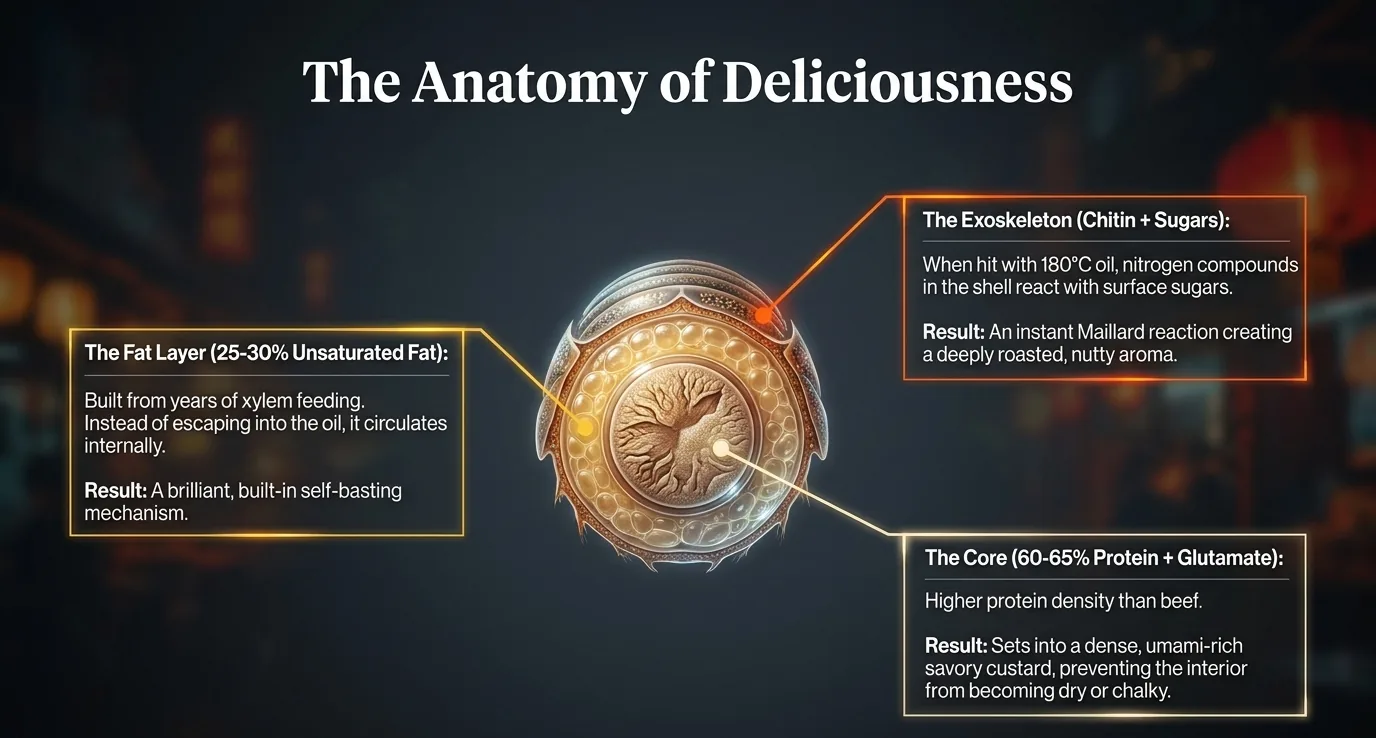
- 60–65% protein by dry weight — a higher protein density than beef, chicken, or most conventional protein sources.
- 25–30% fat — primarily unsaturated fatty acids accumulated from years of xylem feeding, with a flavor profile that is nutty and rich rather than greasy.
- Significant quantities of amino acids — including glutamate, the compound responsible for umami flavor.
When this composition hits 180°C oil, several things happen simultaneously:
The Maillard reaction begins immediately on the exoskeleton surface — the same browning chemistry that creates the crust on a steak or the color on bread. The chitinous exoskeleton contains nitrogen compounds that react with the nymph's surface sugars to create hundreds of flavor compounds, producing that distinctive nutty, roasted aroma.
The fat renders from the abdominal tissue, basting the interior proteins as they cook. This self-basting effect is what gives properly fried cicada nymphs their rich, almost buttery interior — the fat doesn't escape into the oil, it circulates within the abdomen.
The proteins set into a dense, cohesive paste — not dry and chalky like overcooked meat, but creamy and rich because of the surrounding fat content. The texture of the cooked abdomen is often compared to a very dense, savory custard or the interior of a perfectly cooked egg yolk.
The result: an ingredient with a crispy shell and a rich, creamy, intensely savory interior — a textural contrast engineered not by any human technique, but by seventeen years of biological preparation.
Biology did the prep work so the cook doesn't have to. Seventeen years underground. Three minutes in the oil.
6. The seasoning options
The cicada nymph, post-fry, accepts seasoning with the enthusiasm of something that has been waiting seventeen years for this moment.
The Classic: Salt and Chili. Coarse salt, ground dried chili, a pinch of cumin. Tossed immediately after frying while the exoskeleton is still hot enough for the seasoning to adhere. This is the Shandong night market standard — simple, direct, letting the nymph's own flavor lead.
The Sichuan Version: Má Là. Sichuan peppercorn powder and dried chili, applied after frying. The numbing-spicy combination plays against the rich, fatty interior in a way that is deeply, irrationally satisfying.
The Barbecue Version: 烧烤知了猴. Skewered whole on bamboo, brushed with oil and seasoned, cooked over charcoal. Slower than frying, smokier in flavor, with the exoskeleton taking on a slight char at the edges. The interior is slightly less creamy than the fried version, but the smoke adds a dimension that the oil alone cannot.
The Purist Version: Just Salt. For people who want to taste seventeen years of tree root sap and nothing else. Valid. Extremely valid.
7. The numbers
- 2–17 years underground depending on species (most Chinese cicadas: 3–5 years).
- 17°C soil temperature that triggers emergence — the biological alarm clock.
- 2–4 hours window between emergence and exoskeleton-shedding.
- 3–4 weeks total annual season in northern China.
- 180–190°C the only acceptable frying temperature.
- 3 minutes total cook time.
- 60–65% protein content by dry weight — higher than beef.
- 0 other ingredients that spent this long preparing to be your snack.
The verdict
A cicada nymph spent years underground doing nothing visible, accumulating protein and fat with the patience of someone who knew exactly what they were building toward. It emerged at night, climbed a tree, and got collected by someone with a flashlight. Three minutes in hot oil later, it became one of the most texturally and nutritionally dense snacks in Chinese street food culture — crispy shell, creamy interior, nutty Maillard crust, seventeen years of flavor compressed into a single bite.
This is not a dare. This is not a stunt. This is biology doing the prep work so the cook doesn't have to.
And if the patience-and-transformation narrative at the heart of this craft sounds familiar, it should: our Huozhuzi chapter runs a similar biological clock on a completely different ingredient. Same patience. Different method.