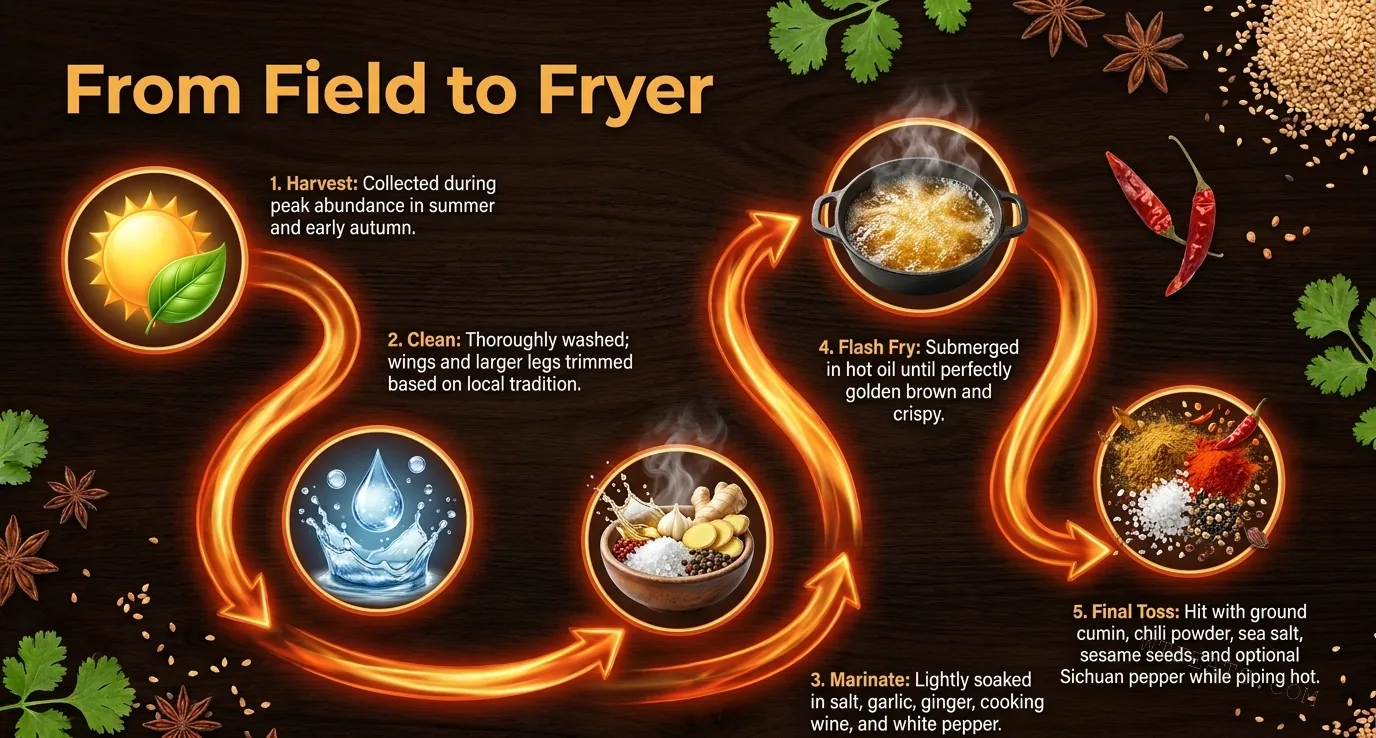
Let's be honest about what this is. This is an insect that spent its entire life cycle in the grasslands and fields of northern China, feeding on grasses and plants, growing through the warm months of summer. And then, at the peak of its abundance, it gets collected, cleaned, seasoned, and dropped into screaming-hot oil for exactly 2 to 3 minutes. What emerges is one of the crunchiest, most addictive snacks in Chinese street food culture.
The reason fried grasshoppers work — and why they have endured as a tradition for generations — is not despite their simplicity, but because of it. The ingredient does not need to be disguised or complicated. It needs to be respected: collected at the right time, cleaned properly, fried at the right temperature, and seasoned while still hot. Understanding that process is the key to understanding why this snack is genuinely, texturally extraordinary.
1. The harvest: a narrow seasonal window
Grasshoppers are collected during the summer and early autumn when they are most abundant. This is not a year-round operation — the harvest window is strictly limited to the warm months, roughly June through September in most of northern China.
Experienced collectors know the signs: the fields and grasslands teeming with activity, the insects at their largest and most flavorful. The grasshoppers are typically gathered in the early morning or late evening when they are less active and easier to catch. A skilled collector can gather a substantial quantity in a single outing.
The timing matters enormously. Grasshoppers caught too early in the season are small and underdeveloped. Grasshoppers caught too late may have begun to harden or lose their peak flavor. The sweet spot is mid-summer — when the insects are fully grown, plump, and carrying the maximum nutritional density.
2. The purge: patience before the fry
Before any cooking happens, the collected grasshoppers must be purged. This is a step that separates the home cook from the street-food professional — and it is non-negotiable.
The Purge. Fresh grasshoppers are placed in a ventilated container — traditionally a basket or jar with a breathable cover — and left for approximately 48 hours. During this time, the grasshoppers empty their digestive systems, clearing out any remaining plant matter. This step is essential for both flavor and food safety.
After purging, the grasshoppers are given a thorough rinse in clean water. Some traditional preparations also involve a brief blanching in boiling salt water to further clean and slightly firm the bodies. The wings and larger hind legs may be trimmed at this stage, depending on local preference — some cooks leave them intact for maximum crunch, others trim them for easier eating.
3. The marinade: building the flavor base
The marinade is where the first layer of flavor is established. Unlike heavy marinades that mask the ingredient, this is a light seasoning bath designed to enhance the grasshopper's natural nuttiness.
The traditional marinade consists of:
- Salt — to draw out moisture and season the interior
- Garlic — grated or minced, for aromatic depth
- Ginger — sliced, for warmth and complexity
- Cooking wine (Shaoxing) — to tenderize and remove any lingering grassy notes
- White pepper — for a subtle, clean heat
The grasshoppers are soaked in this mixture for 15 to 30 minutes — long enough to absorb flavor, short enough not to soften the exoskeleton. After marinating, they are drained and patted completely dry. Moisture is the enemy of a good fry; any remaining water will cause violent splattering and prevent the exoskeleton from achieving its signature crispness.
4. The fry: where two minutes becomes magic
Oil temperature: hot — approximately 180 to 190°C. The exact temperature matters less than consistency; what matters is that the oil is hot enough to flash-fry the exterior without overcooking the interior.
Seconds 0–30: The grasshoppers hit the oil and immediately begin to transform. The exterior moisture flash-evaporates, and the exoskeleton begins to set and harden. Color shifts from pale green-brown to light gold.
Seconds 30–90: The proteins in the body begin to cook through. The interior firms up while remaining light and airy. The legs and wings become increasingly brittle and crisp. The color deepens toward a rich golden-brown.
Seconds 90–180: Full transformation. The exoskeleton is now structurally crispy in a way that shatters rather than bends. The body has developed its characteristic light, airy texture. The color is deep amber-gold. The aroma is extraordinary — nutty, savory, with a faint sweetness from the caramelizing proteins.
Out. Drain. Immediately into the seasoning bowl. Total fry time: 2 to 3 minutes. Not one second more.
5. The seasoning: the final toss
This is the part that makes fried grasshoppers unmistakably Chinese. The seasoning is applied immediately after frying, while the exoskeleton is still hot enough for the spices to adhere.
The classic Shandong seasoning blend:
- Ground cumin — warm, earthy, the dominant note
- Chili powder — for heat and color
- Sea salt — to amplify every other flavor
- Toasted sesame seeds — for nuttiness and texture
- Crushed garlic — for aromatic punch
- Sichuan pepper (optional) — for the signature málà numbing heat
The grasshoppers are tossed vigorously in a large bowl with the seasoning mix, ensuring every surface is coated. Some vendors add a final garnish of chopped green onions and fresh cilantro just before serving — the cool, fresh herbs providing a perfect counterpoint to the hot, crispy insects.
6. The texture science
What makes fried grasshoppers texturally unique is the combination of two very different structures in one small package:
The exoskeleton — made primarily of chitin, a tough polysaccharide. When hit with hot oil, the chitin dehydrates and rigidifies, creating a brittle, shattering shell. The thinner sections — wing membranes, leg joints — become almost glass-like in their delicacy.
The body — composed of protein-rich muscle tissue and internal organs. At 180°C, the proteins denature and set into a light, airy structure. The small amount of internal fat renders slightly, creating a self-basting effect that keeps the interior from drying out.
The result is an ingredient with a crispy, shattering exterior and a light, airy interior — a textural contrast that is achieved not by human technique, but by respecting the ingredient's natural structure and applying the right amount of heat for the right amount of time.
The crunch is not an accident. It is the result of millions of years of evolutionary engineering, unlocked by three minutes of human heat.
7. The cultural significance
Eating edible insects has a long history in many parts of China, especially in regions where seasonal insects were readily available. Fried grasshoppers are more than just a novelty — they represent traditional knowledge of seasonal ingredients and local cooking practices.
In Beijing, Tianjin, Hebei, and Shandong, the tradition of eating fried grasshoppers dates back centuries. During historical locust plagues, communities in affected regions turned the pest into a food source — a practical response that evolved into a beloved seasonal tradition. The insects were salted, dried, or fried and sold in markets under names like "huang mi" (蝗米, "locust rice") and "han xia" (旱虾, "dry shrimp").
Today, fried grasshoppers are often enjoyed as a snack with friends, particularly at outdoor markets and evening food stalls. As interest in edible insects grows worldwide, they have also attracted attention from travelers looking to experience unique local foods.
8. The numbers
- 2 days purge time in a ventilated container.
- 15–30 min light marinade in salt, garlic, ginger, and cooking wine.
- 180–190°C the ideal oil temperature for flash-frying.
- 2–3 min total cook time. Not one second more.
- 3 months approximate annual harvest season in northern China.
- 4 provinces where the tradition is strongest: Shandong, Hebei, Henan, Inner Mongolia.
- 0 other snacks that sound like breaking glass when you bite them.
The verdict
A grasshopper spends months in the fields of northern China, feeding, growing, and preparing for a life cycle that nature intended. Instead, it gets collected at peak summer abundance, purged, marinated, flash-fried for exactly 2 to 3 minutes, and tossed with cumin, chili, and sesame while still hot enough to sizzle.
What emerges is one of the most texturally extraordinary snacks in Chinese street food culture — a shattering crunch, a nutty savoriness, and a seasoning profile that has been refined over generations of summer night markets. This is not a dare. This is not a stunt. This is a tradition.
And if the patience-and-transformation narrative at the heart of this craft sounds familiar, it should: our Zhiliao Hou chapter runs a similar biological clock on a completely different ingredient. Same patience. Different crunch.