From the outside, a huozhuzi stall looks like the least dramatic food operation in China: a pot of plain brown eggs, kept warm, sold by the piece. Nothing about it announces that you are looking at one of the most precisely timed foods in the world — a snack whose entire identity depends on pulling an egg out of an incubator inside a window roughly 48 hours wide.
Miss the window early and you have an expensive boiled egg. Miss it late and you have mao dan — a hairy egg with hardening bones and emerging feathers, a different food with a different (and much narrower) fan base. Hit it, and you have the living pearl.
1. Three names for one egg
The food answers to three names, and each one tells you something true. Huozhuzi (活珠子), "living pearl," comes from candling: held against a bright lamp, the early embryo rolls inside the shell like a translucent bead. Mao Dan (毛蛋), "hairy egg," describes what the same egg becomes a few days later, when fine feathers emerge — a name often used loosely, sometimes incorrectly, for the younger egg too. Wang Ji Dan (旺鸡蛋), "vigorous egg," is the affectionate regional name, emphasizing life force and nourishment.
The naming confusion matters practically: vendors and internet videos routinely blur huozhuzi (the tender 11–13 day egg) and mao dan (the late-stage or failed-incubation egg). They look similar from outside the shell. Inside, they are completely different eating experiences.
2. The candling ritual
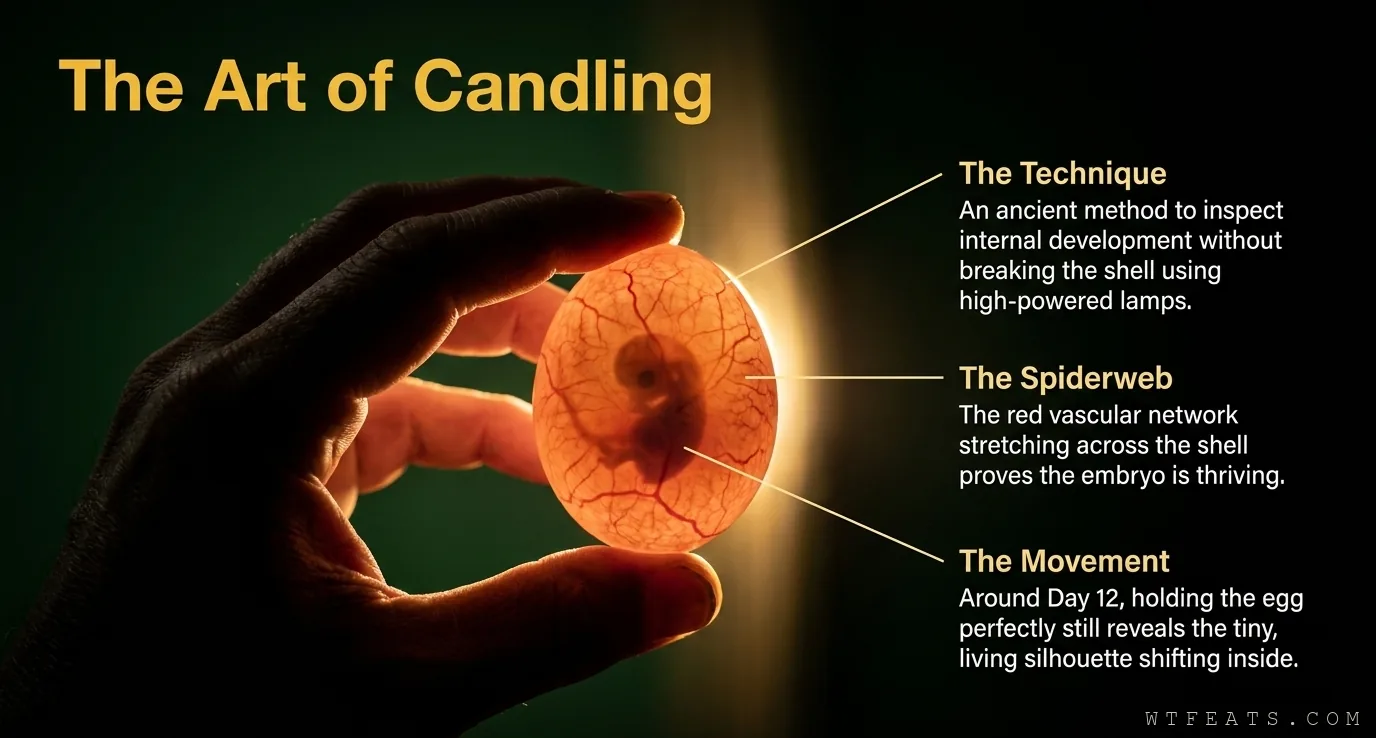
How do you check an embryo without breaking the shell? You shine a light through it. Candling — named for the original light source — is an embryology method as old as poultry keeping. The farmer takes the egg into a dark room and presses it against a high-powered lamp. The shell goes translucent, and the interior reads like an X-ray.
A healthy egg at the right age shows a red vascular network stretching across the shell like a spiderweb — the embryo's lifeline, proof that it is alive and developing on schedule. Hold the egg perfectly still around day 12 and something remarkable happens: the small dark silhouette inside shifts. It moves. This is the sight that earned the egg its name — a living pearl, rolling in its shell.
Candling is also the quality gate of the whole craft. Eggs with no vascular web (infertile or failed) are pulled from the batch. Eggs running ahead or behind schedule are separated. Only the eggs developing exactly on time make it to the pot on harvest day.
3. The 21-day window, day by day
A fertilized chicken egg needs 21 days to hatch. Huozhuzi lives and dies by what happens inside that countdown:
Day 1–3 — the invisible phase. The fertilized cells are dividing, but nothing is visible; the egg looks, weighs, and cooks exactly like an ordinary egg. Day 4–6 — the spark. The first blood vessels form, reaching outward from a tiny dark dot: the embryo announcing itself. Day 7–9 — the network. The vascular spiderweb becomes dense and unmistakable under the lamp; this is the standard checkpoint for confirming fertility. Day 10–11 — the embryo grows visibly; the head and eyes begin to form, and a still egg under the lamp starts to show movement.
Day 11–13 — the harvest. The embryo has a head, wings, and feet in miniature, but the bones are still soft and unformed. The yolk has been partially transformed (more on that alchemy below), the broth is rich, and every texture is at its most tender. This is the entire point of the exercise. Day 14 and beyond — mao dan territory. Bones begin to harden, feathers begin to grow, and the eating experience changes category. Left alone to day 21, of course, the shell opens and a chick steps out.
A huozhuzi is a countdown interrupted at the exact moment the egg becomes more than an egg — and before it becomes anything else.
4. The science of extreme umami
Here is the part that surprises even people who happily eat the egg: the embryo has been seasoning your meal from the inside. During incubation, the developing embryo metabolizes the yolk — breaking its fats and proteins down and rebuilding them into its own growing tissues. A side effect of that construction project is a far more complex profile of free amino acids, the compounds the human tongue reads as umami.
That is why the broth inside a huozhuzi tastes deeper than any stock you could make from a boiled egg, and why the yolk eats creamier and savorier than its un-incubated twin. You are not just eating an egg. You are eating an egg that has upgraded its own nutritional architecture — concentrating protein, minerals, vitamins, lutein, and lecithin in the process.
5. Huozhuzi vs balut: same idea, different egg
Every international visitor asks the same question, because the Philippines' balut is the world's most famous fertilized egg. The comparison is fair — the technique itself traveled from China to Southeast Asia with Chinese migrants — but the two foods have diverged into distinct traditions.
Balut is usually duck, incubated 16–21 days: a late-stage embryo with distinct feathers, formed bones, and a firm texture with an audible crunch. Huozhuzi is chicken, incubated 12–13 days: an early, delicate embryo with no feathers and bones too soft to notice, in a texture that is soft, creamy, and soup-like. If balut is a bar snack with a dare attached, huozhuzi is closer to a breakfast comfort food. Similar in concept. Unmistakably different in the mouth.
6. From farm to night market
The supply chain is four steps long and tolerates no improvisation. Select: farmers isolate the highest-quality naturally fertilized eggs — the candling lamp decides. Incubate: the eggs spend exactly 12–13 days under strict temperature control; the calendar is not a suggestion. Cook: the eggs are gently boiled or steamed, enough to set the yolk softly without driving off the broth. Serve: they are kept warm and sold fresh — at street stalls, traditional markets, and breakfast counters across Nanjing and Jiangsu, seasoned at the table with salt, white pepper, chili powder, or a splash of soy sauce.
7. How to eat one like a local
The ritual has four moves, and the order matters. The Crack: tap the wider top end of the shell against the table to open a coin-sized hole. Resist the urge to peel — the shell is your bowl. The Sip: tip the egg and drink the warm broth pooled at the top. This is the moment that converts skeptics; it tastes like concentrated chicken soup with the volume turned up. The Seasoning: a pinch of salt, white pepper, or roasted chili powder dropped straight into the opening. The Scoop: now peel back more of the shell and use a small spoon to eat the creamy yolk and the pearl itself, soft bones and all.
Many Nanjing locals eat huozhuzi for breakfast or as an afternoon snack, the way other cities eat tea eggs. Nobody at the stall will be watching you. It is not a dare there. It is just lunch.
The numbers
- Harvest window: 11–13 days of incubation — roughly 48 hours of perfection.
- Full hatch: 21 days, if the countdown is allowed to finish.
- Names: 3 — living pearl, hairy egg, vigorous egg — for one egg's different destinies.
- History: 100+ years on Nanjing's streets, back to the Qing Dynasty.
More than just an egg
Huozhuzi began as thrift: a pre-refrigeration preservation technique and an ethos of wasting nothing. The legend says a Qing Dynasty farmer dropped a partially incubated egg on the road; unwilling to waste it, his wife cooked it in the rice pot — and invented a delicacy. Whether or not the story is true, the philosophy is: a century later, the same egg sits at the intersection of agricultural ingenuity, biological alchemy, and cultural heritage.
And if you appreciate what time and chemistry can do to an egg, huozhuzi has a famous cousin: the century egg, transformed not by incubation but by weeks of alkaline curing. Different method, same patience — you can meet it in our Century Egg chapter.