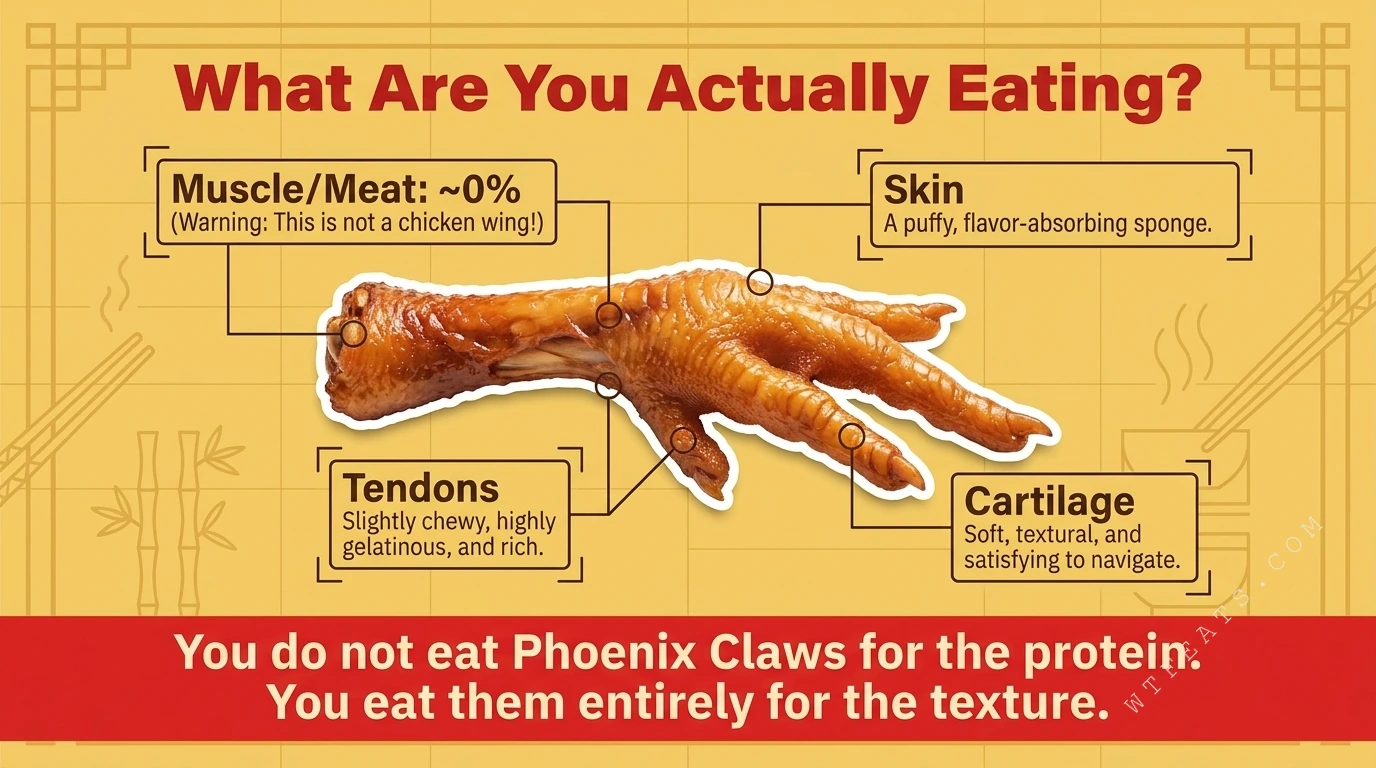
The most common mistake is judging a chicken foot like a chicken wing. There is essentially no meat on it. What there is instead: a layer of skin, a lattice of tendons, small joints of cartilage, and tiny bones. Cooks who understand those materials treat the foot not as a failed drumstick but as a delivery system for texture.
The result can seem impossible if you only know roasted chicken. The skin becomes puffy and sauce-drenched. The tendons turn sticky and gelatinous. The cartilage softens into something you navigate with your tongue. Nothing about it eats like "chicken," which is exactly why it needs a proper explanation.
1. Collagen is the whole game
Skin, tendons, and cartilage are all built from collagen, the structural protein that holds animals together. On its own, raw collagen is tough and rubbery — which is why an undercooked chicken foot is genuinely unpleasant. But given heat, moisture, and time, collagen unwinds and converts into gelatin: the silky, sticky, lip-coating substance that makes a braise feel rich without any fat.
That conversion is the entire point of the dish. A Phoenix Claw is, chemically speaking, a collagen-to-gelatin transformation served on a convenient bone handle.
2. The deep fry is the secret weapon
After the claws are clipped and the feet are blanched, they take a trip through hot oil. This does three things at once. It drives moisture out of the skin. It puffs the skin up with tiny blisters and air pockets, changing it from rubbery to pillowy. And it creates a vast, cratered surface area — a sponge — that will later drink in the braising sauce.
This is why a proper Phoenix Claw looks glossy and swollen rather than skinny. The puff is not an accident of frying; it is the engineered foundation of the whole dish.
3. The cold soak rebuilds the texture
Straight out of the fryer, the feet are dry and brittle. So they go into cold water — sometimes overnight. The dehydrated collagen rehydrates, swelling back into a soft, sticky, pull-apart state. Skip this step and the skin stays leathery no matter how long you braise.
A Phoenix Claw is shocking because it still looks like a foot. It is fascinating because every step of the craft exists to perfect a texture that no other cut of the bird can offer.
4. The master braise: 6–12 hours
Finally, the feet simmer low and slow in a master stock built from soy sauce, oyster sauce, fermented black beans, garlic, and star anise. Over 6 to 12 hours, three things finish at once: the collagen completes its conversion to gelatin, the puffy skin saturates with sauce, and the flavors of the stock penetrate to the bone.
The result is skin that practically melts off the bone, dragging ribbons of soft tendon with it. A good Phoenix Claw should taste deeply savory with a gentle sweetness, never harsh or gamey. If it is rubbery, it was rushed.
5. From waste stream to billion-dollar trade
The economics are as remarkable as the cooking. By the 1990s, American poultry plants were paying to dispose of feet. Then trade routes opened, and at its peak the US exported over $1 billion worth of chicken feet to China annually — a product that had literally negative value at home.
Nor is the foot a Chinese monopoly. Rich, spiced soups in Jamaica and Trinidad; hearty slow-cooked stews across Latin America; "Walkie Talkies" in South Africa; grilled street skewers in the Philippines — collagen-rich feet are cherished worldwide. And the West is finally catching on directly: nose-to-tail eating and collagen-rich diets are culinary frontiers now, and "Braised Phoenix Claws" appear on trendy London, New York, and LA menus at $18 a plate. China has just been doing it for 1,000 years.
How to try it without panicking
Start with dim sum Phoenix Claws (豉汁凤爪): the black bean and garlic sauce is familiar territory, and the steaming makes the texture as gentle as it gets. Graduate to spicy marinated feet (泡椒凤爪) served cold with chili and vinegar when you want the snack version. Choose chicken feet soup when you want the collagen without the chopstick gymnastics.
And learn the etiquette: do not bite it like a drumstick. Bite gently around the joints, let your lips, tongue, and teeth pull the soft tissue away, and deposit the tiny bones neatly to the side. It is a slow, highly social food — enjoy the puzzle at the speed of snacking.
- Muscle content: roughly 0% — it is skin, tendon, and cartilage.
- Key molecule: collagen, converted to gelatin by time and heat.
- Secret weapon: the deep fry that puffs the skin into a sauce sponge.
- Time investment: a 6–12 hour master braise.
- Best beginner dish: dim sum black-bean Phoenix Claws.