A pig ear is immediately, unmistakably, undeniably a pig ear. There is no culinary sleight of hand here. No clever butchery that transforms it into something ambiguous. No Latin name on a restaurant menu that disguises its origin. It arrives looking like an ear because it is an ear — complete with the curved outer rim, the inner ridges, the pointed tip, and the distinct silhouette that your brain recognizes instantly and files under "that is a body part."
Western food culture looks at this and says: no thank you, we'll pass. Chinese food culture looks at this and says: perfect, slice it thin, we need it for the cold platter. The difference between these two responses is not squeamishness versus bravery. It is an understanding — or lack thereof — of what a pig ear actually contains, and what happens to it when you apply the right technique.
1. What is actually in a pig ear
A pig ear is a layered structure. Understanding the layers is understanding why it's worth eating.
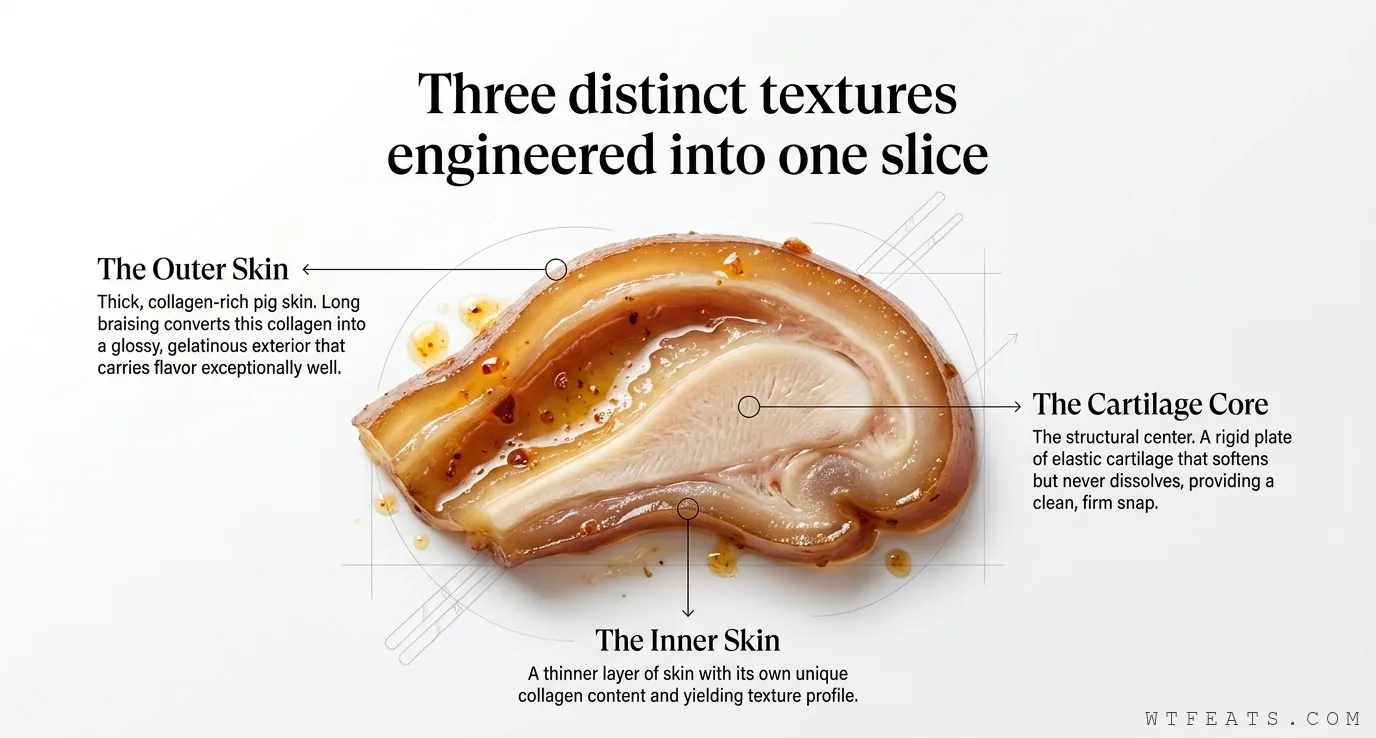
The outer skin. Thick, collagen-rich pig skin. When braised long enough, the collagen converts to gelatin — the same transformation that makes trotters wobble and pork belly melt. Sliced thin and chilled, this layer becomes glossy, slightly sticky, and carries flavor exceptionally well.
The cartilage core. The structural center of the ear — a rigid plate of elastic cartilage that gives the ear its shape. Unlike bone, cartilage does not dissolve during cooking. It softens, it yields, it loses its rigidity — but it maintains its structure. After long braising and chilling, it provides a clean, firm snap when you bite through it.
The inner skin. A thinner layer of skin on the inner surface of the ear, with its own collagen content and texture profile.
The result of these three layers together, after proper braising and slicing: a cross-section that is glossy gelatinous skin on the outside, firm-but-yielding cartilage in the center, glossy skin again on the other side. Three distinct textures in one thin slice, all carrying the flavor of whatever braising liquid they spent the last two hours in. This is why pig ear is prized in Chinese cold dish cuisine. Not despite its structure — because of it.
2. The cleaning: shorter than you'd expect
Compared to pork intestine or tripe, pig ear cleaning is almost relaxing.
Step 1 — The Singe. Remaining hairs on the skin get removed over an open flame or with a kitchen torch — the same technique used for trotters. Quick, effective, slightly dramatic.
Step 2 — The Scrape. A knife, held at an angle, scraped firmly across all surfaces to remove any scorched hair residue and the outermost layer of skin. The ear emerges cleaner and slightly smoother.
Step 3 — The Blanch. Into cold water, brought to a boil with ginger and Shaoxing wine. Five minutes. Out. The water goes grey — impurities, residual blood, the biological evidence of previous existence. Discard it. Rinse the ear under cold running water.
Total cleaning time: fifteen minutes. Practically instant by offal standards. The ear is now ready. It is still very much shaped like an ear. This does not change at any point in the process. Make your peace with it now.
3. The braise: where the transformation happens
Master stock. Always master stock for pig ear.
The aromatics: soy sauce (dark and light), Shaoxing wine, rock sugar, star anise, cinnamon, bay leaves, dried chilies, Sichuan peppercorns, ginger, garlic, dried tangerine peel. The same fundamental architecture as every other Chinese braise, calibrated differently by every cook who makes it.
The ear goes in whole. This is important — braising it whole ensures even penetration of the braising liquid and maintains the structural integrity of the cartilage through the cooking process. You slice after. Never before.
Low heat. Ninety minutes minimum. Two hours preferred.
During this time, the outer skin layers undergo collagen conversion — softening, hydrating, becoming the glossy, gelatin-rich exterior that will make the finished slices shine under the restaurant lighting. The cartilage core softens from rigid to firm-but-yielding — it will never fully dissolve the way bone marrow does, but it loses its raw stiffness and becomes something your teeth can move through cleanly.
At ninety minutes: the skin is soft, the cartilage yields with moderate resistance. Good. At two hours: the skin has deepened in color to a rich mahogany, the cartilage has reached the optimal state — firm enough to provide texture, soft enough to not fight back. The braising liquid has penetrated every layer. This is the window.
4. The chill: not optional
The ear comes out of the braise and goes immediately into the refrigerator — still whole, submerged in a small amount of braising liquid to continue absorbing flavor as it cools. This chilling step is not optional. It is what transforms a warm, somewhat floppy braised ear into a cold, firm, sliceable object with structural integrity.
Minimum chilling time: four hours. Overnight is better.
A properly chilled pig ear holds its shape when you pick it up. It has a slight give when you press it. The gelatin in the skin has set firm enough to hold the slice together. The cartilage has become the backbone of a cohesive, cuttable structure. Now you slice it.
5. The slice: the most important thirty seconds
Pig ear is sliced thin. Very thin. Two to three millimeters maximum.
This is not aesthetic preference. This is texture science.
At two to three millimeters, the cartilage layer provides a clean snap — a satisfying, definitive resistance that your teeth move through in one motion. The skin layers on either side contribute their gelatinous softness as a counterpoint. The overall experience is crisp, yielding, glossy, deeply flavored — the entire textural vocabulary of the ear in one thin slice.
At five millimeters: the cartilage becomes chewy rather than snappy. The texture ratio shifts. The eating experience degrades.
At eight millimeters: you are fighting the cartilage. The cartilage wins.
A sharp knife. A cold ear. Confidence in the cut. Two to three millimeters. This is the discipline.
The ear was listening the whole time. It turns out it also had something to say.
6. The dressing: the final layer
Pig ear does not arrive at the table naked. It arrives dressed.
The standard cold dish treatment: sesame oil, chili oil, garlic (raw, finely minced), light soy sauce, Chinkiang black vinegar, sugar, and fresh chili. Mixed together and poured over the cold slices, tossed to coat every surface.
The sesame oil clings to the gelatin-rich skin. The vinegar cuts through the richness of the braising liquid still embedded in the cartilage. The raw garlic provides a sharp top note against the deep bass of the star anise. The chili oil settles into the spaces between slices.
Every element of the dressing is doing a specific job. None of it is decoration.
Some versions add cucumber — thinly sliced, for a fresh, cool counterpoint to the rich, deeply flavored ear. Some add cilantro. Some add toasted sesame seeds. The core formula stays the same. The result is a cold dish that is simultaneously: rich and fresh, savory and sharp, gelatinous and snappy, deeply aromatic and cleanly finished.
7. The cultural role: China's greatest drinking snack
Pig ear did not end up on the cold platter by accident. It ended up there because of a very specific cultural function: it is one of the greatest drinking snacks ever invented.
Chinese drinking culture — particularly the tradition of xiàjiǔcài — prizes cold, intensely flavored, texturally interesting small dishes that can be eaten slowly over the course of a long meal or drinking session. The dishes need to be flavorful enough to stand up to strong baijiu or cold beer. They need to be interesting enough to keep eating. They need to not be so filling that they interfere with the drinking.
Pig ear ticks every box. The intense soy-and-spice flavoring cuts through alcohol. The complex texture — snappy cartilage, soft gelatin, cool dressing — keeps the eating experience interesting across many pieces. The cold temperature is refreshing. The portion size is calibrated for slow consumption.
In virtually every Chinese city with a drinking culture — which is to say, every Chinese city — pig ear occupies a permanent spot on the cold appetizer menu of every restaurant that takes its xiàjiǔcài seriously. It is, in this context, not exotic. It is not adventurous. It is simply the right thing to eat when there is alcohol on the table.
The West turned it into dog treats. China turned it into the anchor of the cold platter. Same ear. Completely different destiny.
8. The numbers
- 3 layers — skin, cartilage, skin: the structural architecture of every slice.
- 2 hours minimum braising time for full collagen conversion.
- 4 hours minimum chilling time before slicing.
- 2–3mm — the correct slice thickness; deviate at your peril.
- 15 minutes — cleaning time (practically nothing by offal standards).
- 0 — the number of other ingredients that provide this exact texture combination.
The verdict
A pig ear is not a dare. It is not a novelty. It is not the punchline of a "weird food" list. It is a precisely structured piece of anatomy — cartilage wrapped in collagen-rich skin — that responds to braising and chilling with a textural transformation that no other cut can replicate. It is the anchor of China's cold dish culture for the same reason that good wine glasses are made of crystal: the structure matters, and the right structure makes everything taste better.
Slice it thin. Dress it properly. Eat it cold with something to drink.
And if the collagen-to-gelatin transformation at the heart of this craft sounds familiar, it should: our Pork Trotters chapter runs the same conversion on a much larger scale. Same conversion, different architecture. The trotter wobbles; the ear snaps.