You are looking at a pig's foot. It has a hoof. It has knuckles. It weighs about half a kilogram and looks like something that should be in a biology classroom, not on a dinner table. And yet: give it six hours, the right pot, and someone who knows what they are doing, and it becomes one of the most gelatinous, deeply savory, fall-apart-tender things you will ever put in your mouth.
This is not magic. This is collagen chemistry. And it is spectacular — but only if you understand what you are working with.
1. Anatomy: a collagen delivery system
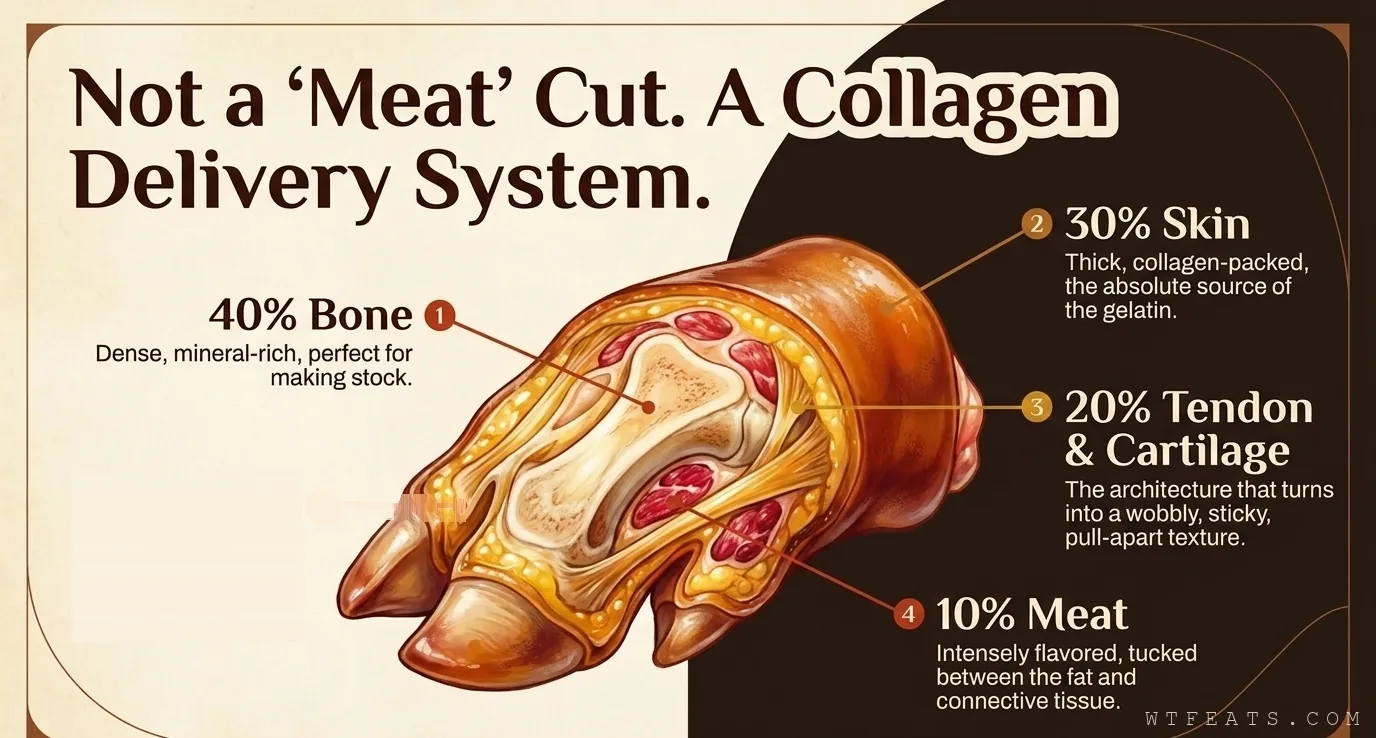
A pig trotter is approximately 40% bone — dense, mineral-rich, and perfect for building body in a sauce. Roughly 30% is skin: thick, collagen-packed, and the source of all the gelatin to come. About 20% is tendon and cartilage, the material that turns into that wobbly, sticky, pull-apart texture. And just 10% is actual meat, tucked between everything else and intensely flavored from spending its entire existence surrounded by fat and collagen.
There is almost no lean muscle here. This is not a "meat" cut in the Western sense. It is a collagen delivery system disguised as a foot — and collagen, it turns out, is the whole point.
2. The intervention: hair, blanch, split
A raw trotter arrives looking exactly like what it is, so stage one is convincing it to cooperate. First, hair removal — yes, pig trotters have coarse, bristly hair. Traditionally the trotter is held over an open flame until the hair singes off, then scraped; the modern method blanches and shaves. Either way, this step exists and it is not for the faint-hearted.
Next, the first blanch: the trotter goes into cold water, is brought to a boil, and drained. This pulls out blood and impurities that would otherwise turn the braising liquid cloudy and bitter. The water turns grey and deeply unappealing. You throw it away. You start fresh.
Finally, the split. A good cleaver, applied with confidence, opens the trotter lengthwise or into sections — exposing more surface area to the braising liquid and releasing the bone marrow, which will slowly dissolve into the sauce and make it extraordinary. The trotter is now ready. It does not look ready. It looks like a crime scene prop. Keep going.
3. Aromatics architecture: red braise vs master stock
Before the trotter goes back in the pot, the braising liquid needs to be built. This is where red-braised trotter (红烧猪蹄) and master-stock trotter (卤猪蹄) diverge — but both start from the same principle: layered aromatics that penetrate the collagen matrix over time.
For the red braise, rock sugar is caramelized in oil until it turns a deep amber — this is the color and the sweetness, and it is non-negotiable. Shaoxing wine deglazes the caramel with an instant sizzle. Then light soy for salinity, dark soy for color, ginger, scallions, and garlic as the foundation, and star anise, cinnamon, bay leaves, and Sichuan peppercorns for complexity. The caramelized sugar is what gives red-braised trotter its lacquered, mahogany finish — glossy rather than merely brown.
The master stock (卤水) takes the opposite philosophy: a dark, ancient soy-based liquid that some restaurants have been maintaining and topping up for decades — a perpetual stew that grows more complex every time something is cooked in it. A 20-year-old master stock is a genuine culinary artifact.
4. The long game: collagen to gelatin at 70°C
The trotter goes into the liquid. The heat drops to a low simmer. And then you wait — because patience here is a personality trait. At sustained temperatures above 70°C, the triple-helix structure of collagen begins to unwind and break down into gelatin. Gelatin is what makes the sauce coat a spoon. Gelatin is what makes the trotter wobble when you poke it. Gelatin is the whole game.
Hour 1: the skin softens, aromatics begin penetrating the outer layers, and marrow starts leaching from the split bones into the liquid. Hour 2: the collagen in the skin is actively converting — the key transformation. Hour 3: tendons begin to dissolve, knuckle cartilage softens from rigid to yielding, and the meat starts pulling away from the bone. Hours 4–5: peak transformation. The skin reaches a state food scientists call "melt-in-mouth," the tendons become soft ribbons, and the cartilage takes on the texture of firm jelly. Hour 6: done. Pick it up with chopsticks and it wobbles. Pull at the skin and it separates in sheets. This is not overcooked. This is exactly cooked.
A braised trotter is a structural engineering project in edible form — simultaneously falling apart and holding itself together.
5. The reduction: the final boss
The trotter comes out. The braising liquid goes back on high heat. As the water evaporates, the gelatin concentration climbs, the sugars caramelize further, and the soy deepens — until the sauce transforms from a thin braising liquid into a thick, glossy reduction that coats the back of a spoon and clings to the trotter like it has opinions about leaving.
This sauce is poured back over the trotter, which now sits mahogany-colored, shiny, trembling slightly, smelling of star anise and caramelized soy and something deep and primal that your brain files under "extremely important, eat immediately."
What you are actually eating
Pull apart a properly braised trotter and here is what happens in your mouth. The skin dissolves almost immediately — pure hydrated gelatin, rich with absorbed braising liquid. The tendon offers a slight resistance before giving way: the characteristic "Q" texture Chinese food culture prizes, somewhere between firm and yielding, with a satisfying clean snap. The cartilage at the knuckles is soft and slightly grainy — the most polarizing part for first-timers, and the most addictive for everyone else. The meat, what little there is, falls off the bone infused with six hours of aromatics.
And underneath all of it: collagen. So much collagen that your lips literally start sticking together slightly. This is not a problem. This is the point.
The numbers
- Braising time: 6–8 hours minimum for full collagen conversion.
- Collagen content: ~28% of raw pig skin by weight — one of the highest of any cut.
- Conversion temperature: 70°C, where collagen begins turning to gelatin.
- Shortcuts: 0 — the number that produce an equivalent result.
How to try it without panicking
Start with Hong Shao Ti (红烧猪蹄): the sweet-savory red braise is familiar territory, and the glossy sauce makes the texture as approachable as it gets. Graduate to Laoma Tihua (老妈蹄花) when you want the milky, collagen-thick Chengdu soup version — the trotter arrives so tender it gives up before your chopsticks do. And if you are traveling, know that the trotter is a pan-Asian language: order Jokbal in Seoul, Crispy Pata in Manila, or a dark soy-braised trotter in Taipei, and you will find the same chemistry speaking different dialects.
A pig trotter is not a glamorous cut. It does not photograph well raw. It requires commitment, a cleaver, and the patience to let chemistry do what chemistry needs to do. But what comes out of that pot after six hours is not just food — it is proof that time plus technique beats pedigree every single time.
The hoof goes in. The Phoenix comes out. And if that line rings a bell, meet the trotter's smaller, crunchier cousin in our Phoenix Claws chapter. Different animal. Same alchemy.