Visual Story

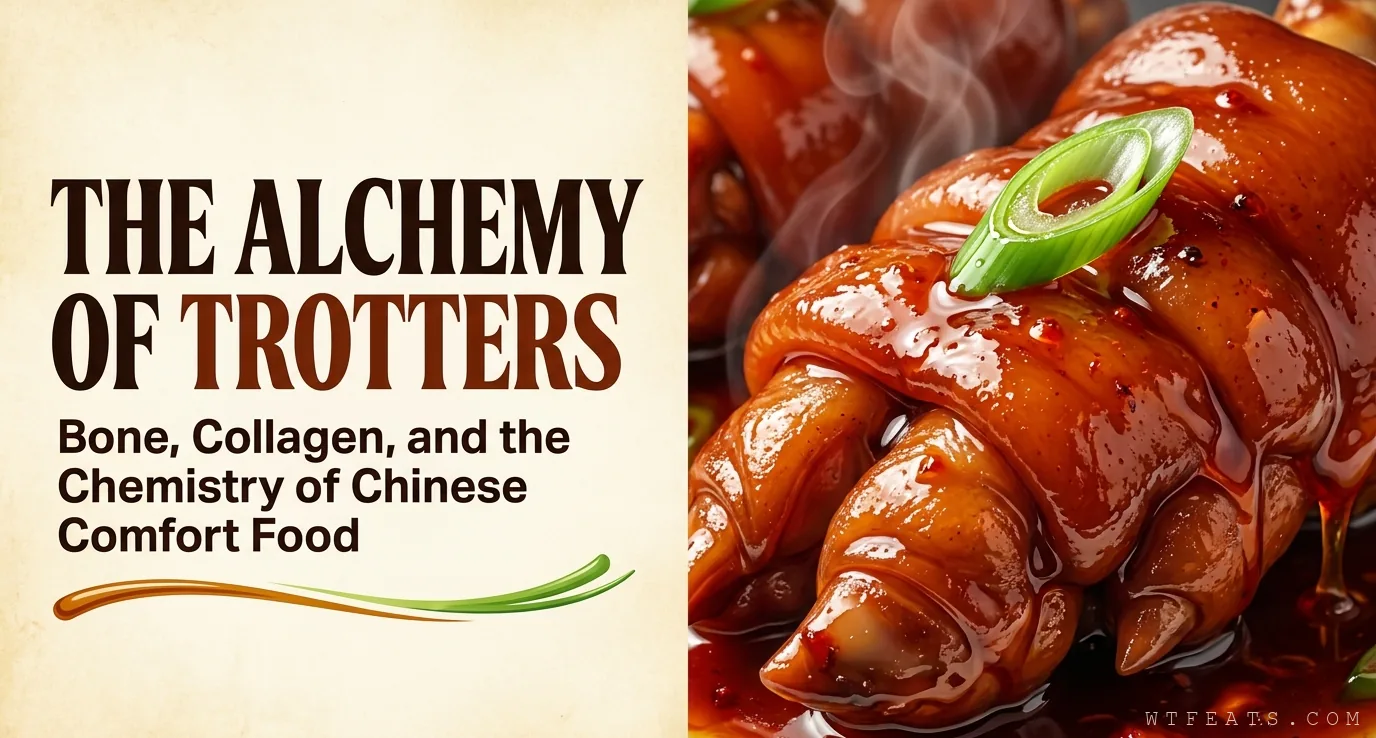
The Alchemy of Trotters

You are looking at a pig's foot. It has a hoof, knuckles, and about half a kilogram of structural problems. Give it six hours, the right pot, and someone who knows what they are doing — and it becomes one of the great texture dishes of Chinese cuisine. This is not magic. This is collagen chemistry. And it is spectacular.

The Alchemy of Trotters title slide: a glossy braised pork trotter on the right half
The Paradox
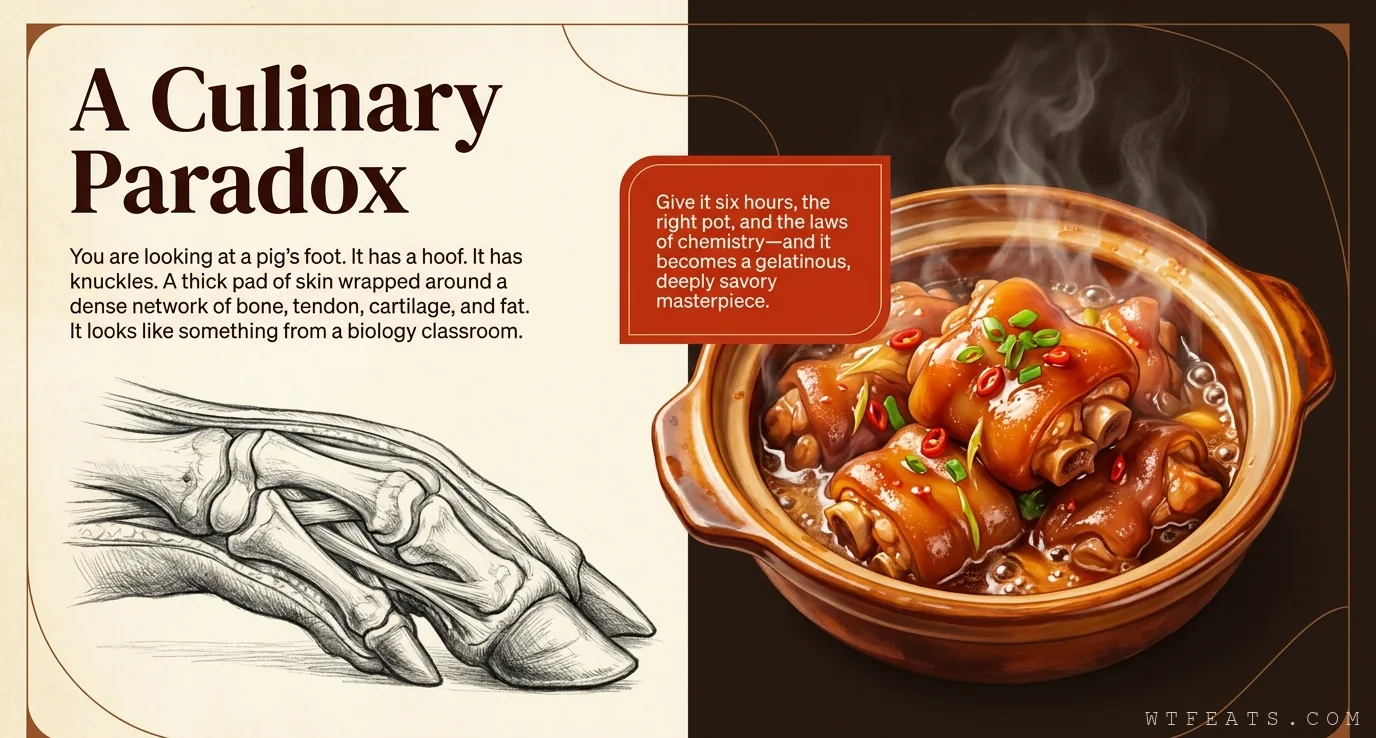
A culinary paradox: pig foot sketch versus a clay pot of braised trotters

A culinary paradox.

Raw, a trotter looks like something that belongs in a biology classroom, not on a dinner table. Cooked properly, it is the dish people order first and fight over last. The entire craft exists to close the distance between those two images.
The Anatomy
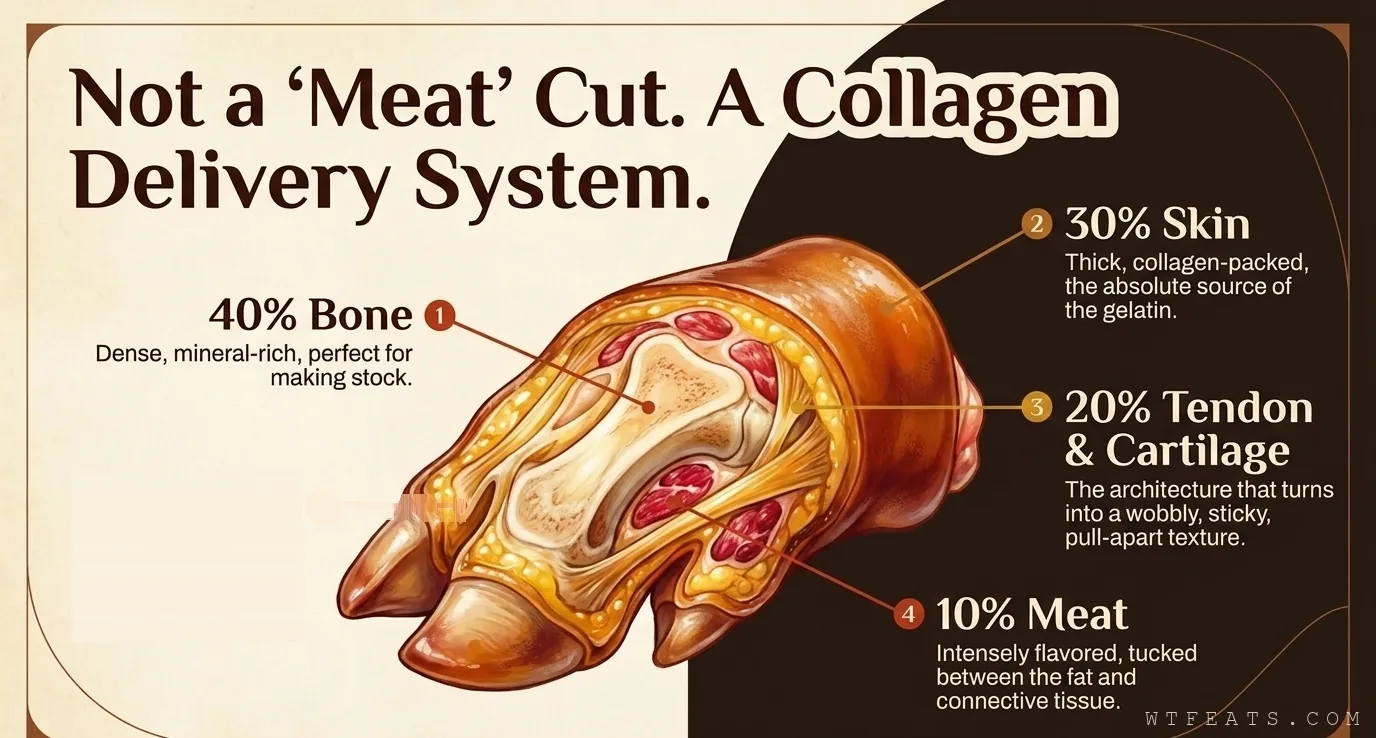
Trotter anatomy: 40 percent bone, 30 percent skin, 20 percent tendon and cartilage, 10 percent meat

Not a “meat” cut. A collagen delivery system.

Break it down: 40% bone — dense, mineral-rich, perfect for stock. 30% skin — thick, collagen-packed, the source of all the gelatin. 20% tendon and cartilage — the stuff that turns wobbly and sticky. 10% actual meat — tucked between everything else, intensely flavored by its surroundings.

Lean muscle? Barely present. That was never the point.

The Chemistry
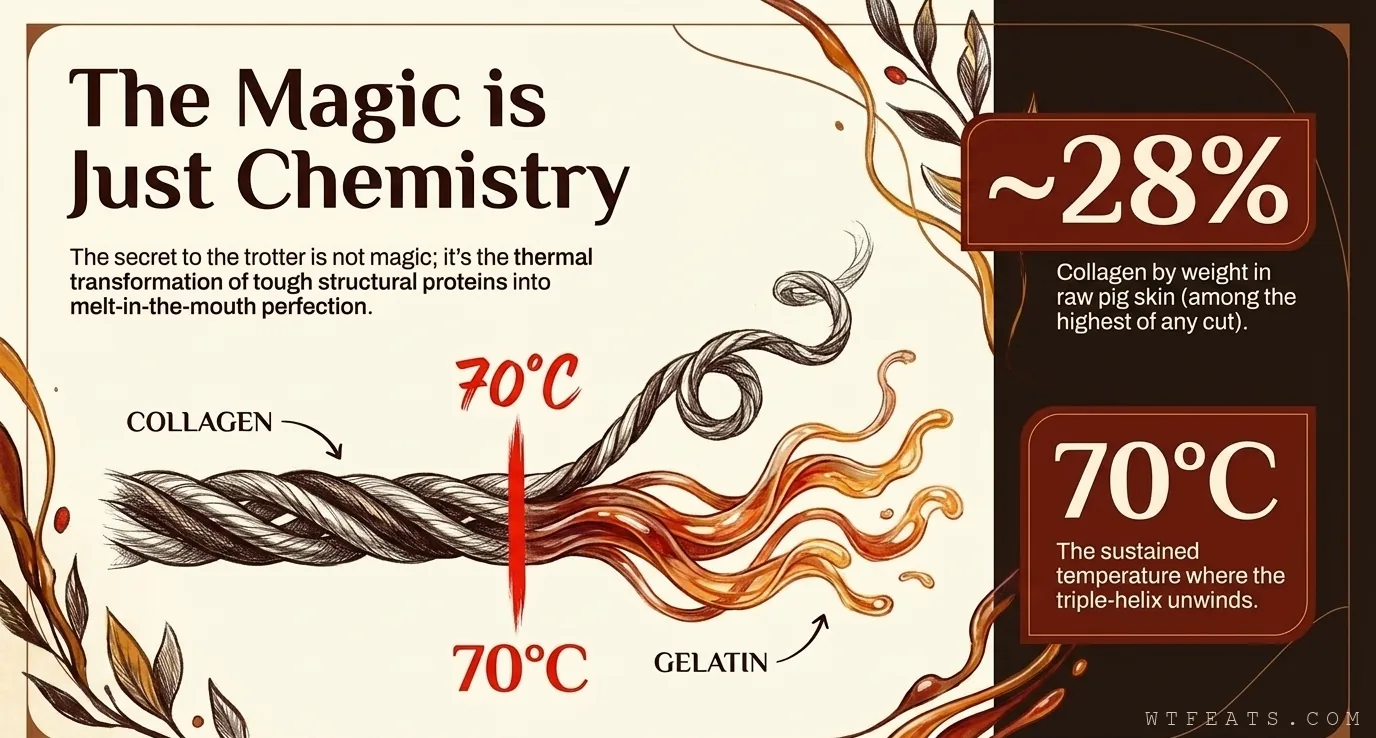
The magic is just chemistry: collagen converting to gelatin at 70 degrees Celsius

The magic is just chemistry.

Collagen is a tough, fibrous protein that keeps skin and tendons rigid. Hold it above 70°C with moisture and time, and its triple-helix structure unwinds into gelatin — the substance that makes a sauce coat a spoon and a trotter wobble when you poke it. Pig skin runs about 28% collagen by weight, one of the highest of any cut.

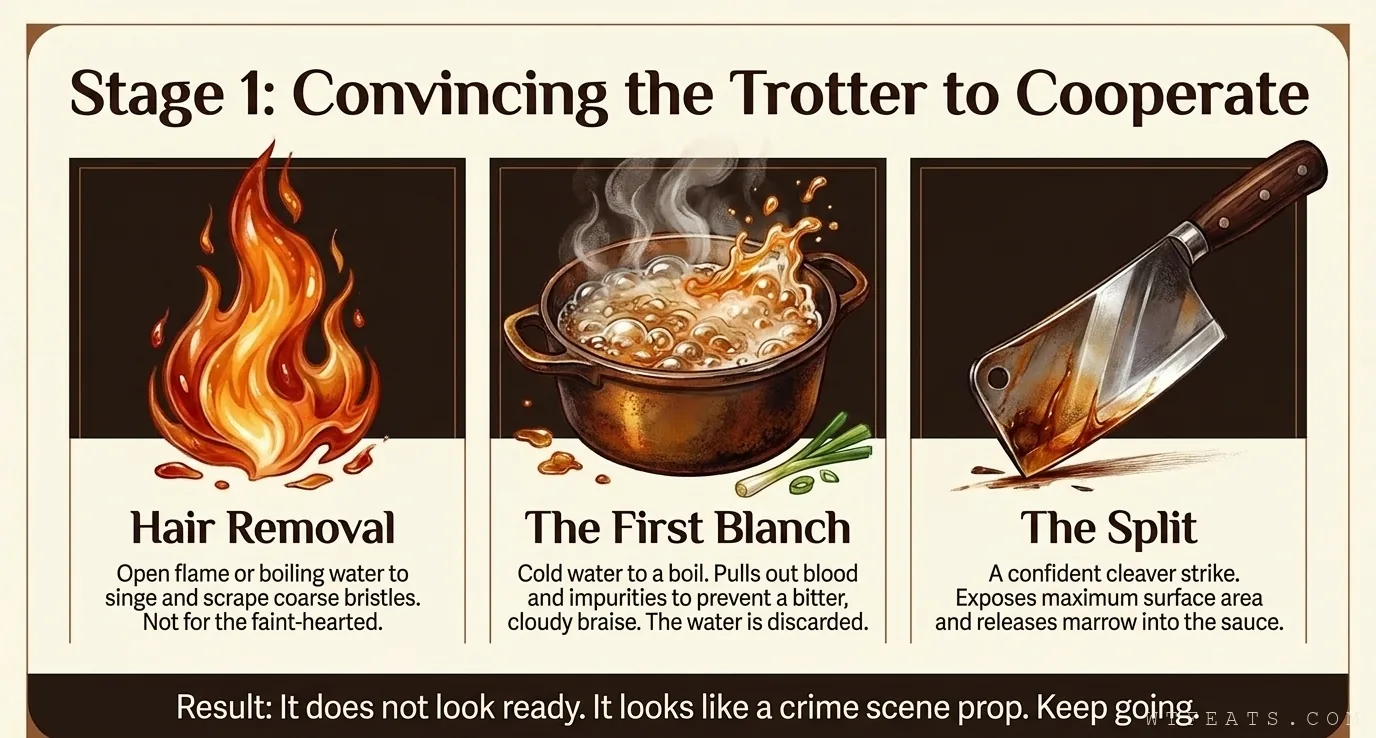
Stage 1: Prep
Stage one: hair removal, the first blanch, and the split

Convincing the trotter to cooperate.

First, the hair: yes, trotters have bristles — singed or blanched off, then scraped clean. Then the first blanch: cold water brought to a boil and drained, pulling out blood and impurities that would cloud the braise. Finally, the split: a confident cleaver opens the trotter lengthwise, exposing surface area and releasing the marrow that will enrich the sauce.

It now looks like a crime scene prop. Keep going.

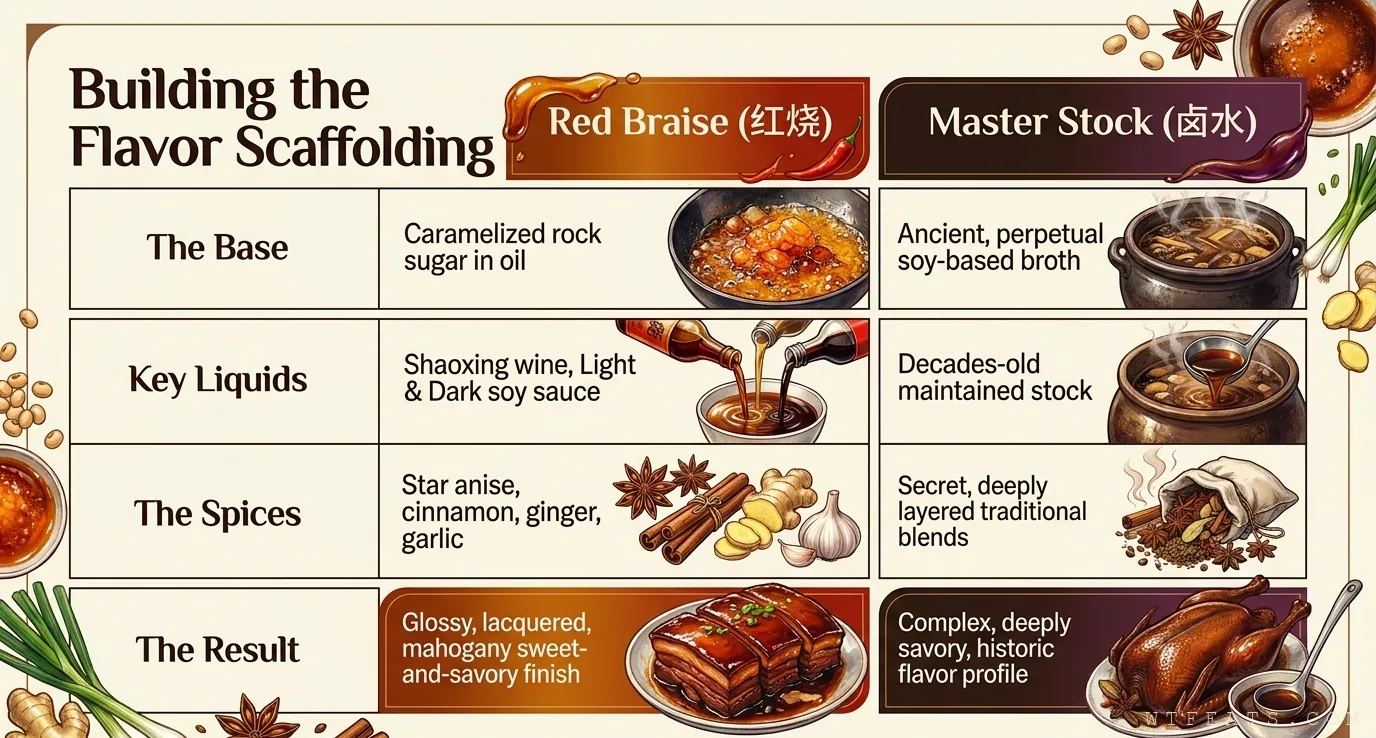
The Scaffolding
Building the flavor scaffolding: red braise versus master stock

Two roads to flavor.

The red braise (红烧) starts with rock sugar caramelized in oil to a deep amber — the source of that lacquered mahogany color — then Shaoxing wine, light and dark soy, ginger, scallion, star anise, and cinnamon. The master stock (卤水) is a dark soy-based liquid some restaurants have kept alive for decades, growing more complex with every braise.

A 20-year-old master stock is a genuine culinary artifact.

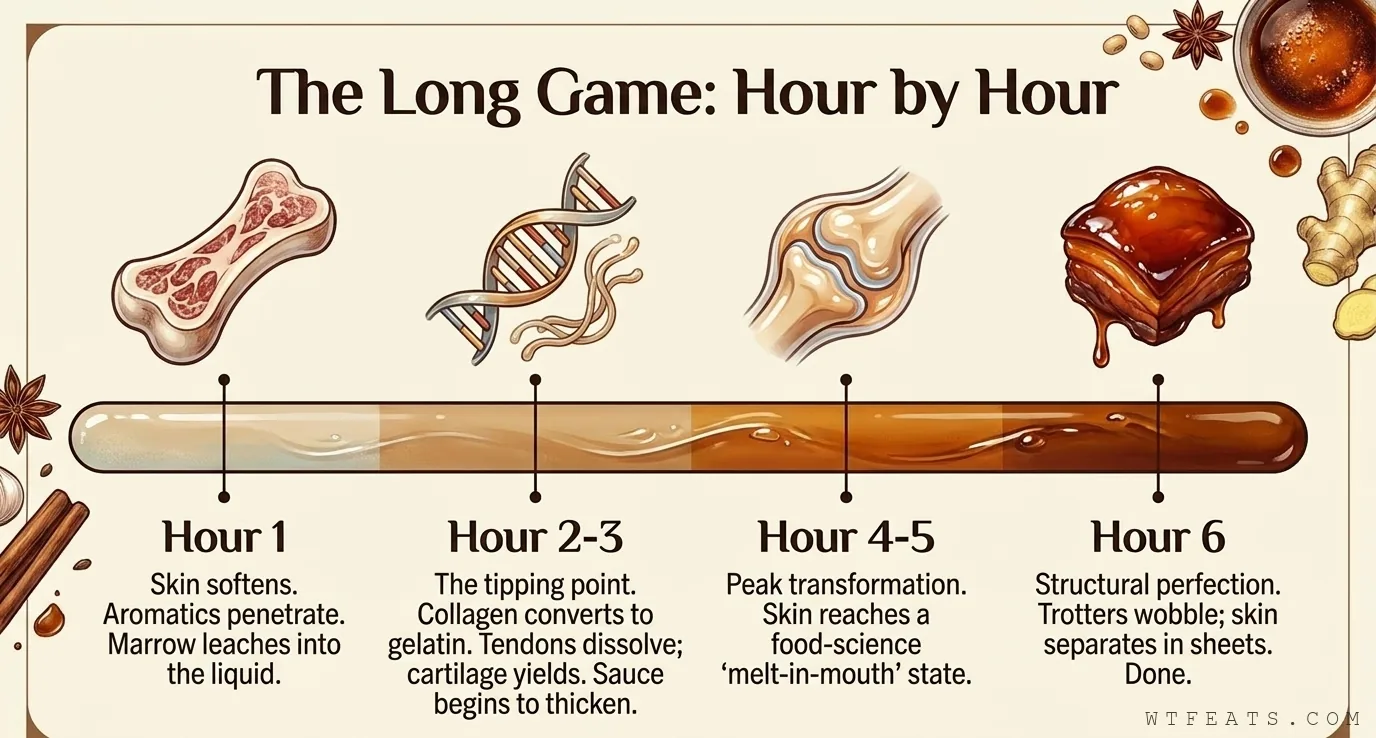
The Long Game
The long game: an hour by hour timeline from hour one to hour six

Hour by hour, the pot does its work.

Hour 1: the skin softens, the aromatics start penetrating, marrow leaches into the liquid. Hour 2: collagen begins its conversion to gelatin. Hour 3: tendons dissolve, cartilage turns yielding, meat pulls from the bone. Hours 4–5: peak transformation — the skin reaches melt-in-mouth, the tendons become soft ribbons. Hour 6: done. It wobbles. The skin separates in sheets.

This is not overcooked. This is exactly cooked.

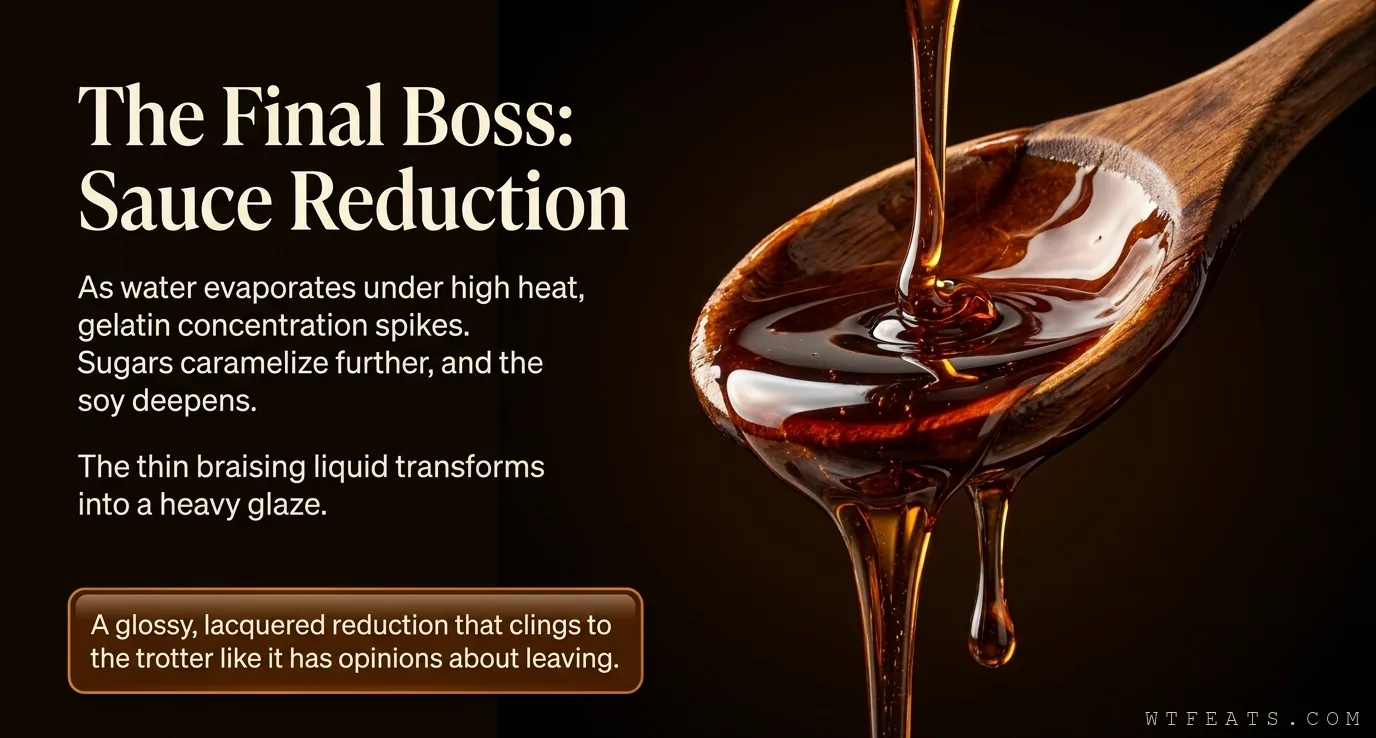
The Reduction
The final boss: a ladle of glossy reduced sauce

The final boss: sauce reduction.

The trotter comes out. The liquid goes back on high heat. As water evaporates, gelatin concentrates, sugars caramelize further, and the soy deepens — until the sauce coats the back of a spoon and clings to the trotter like it has opinions about leaving. Then it gets poured back over the top.

The Cross-Section
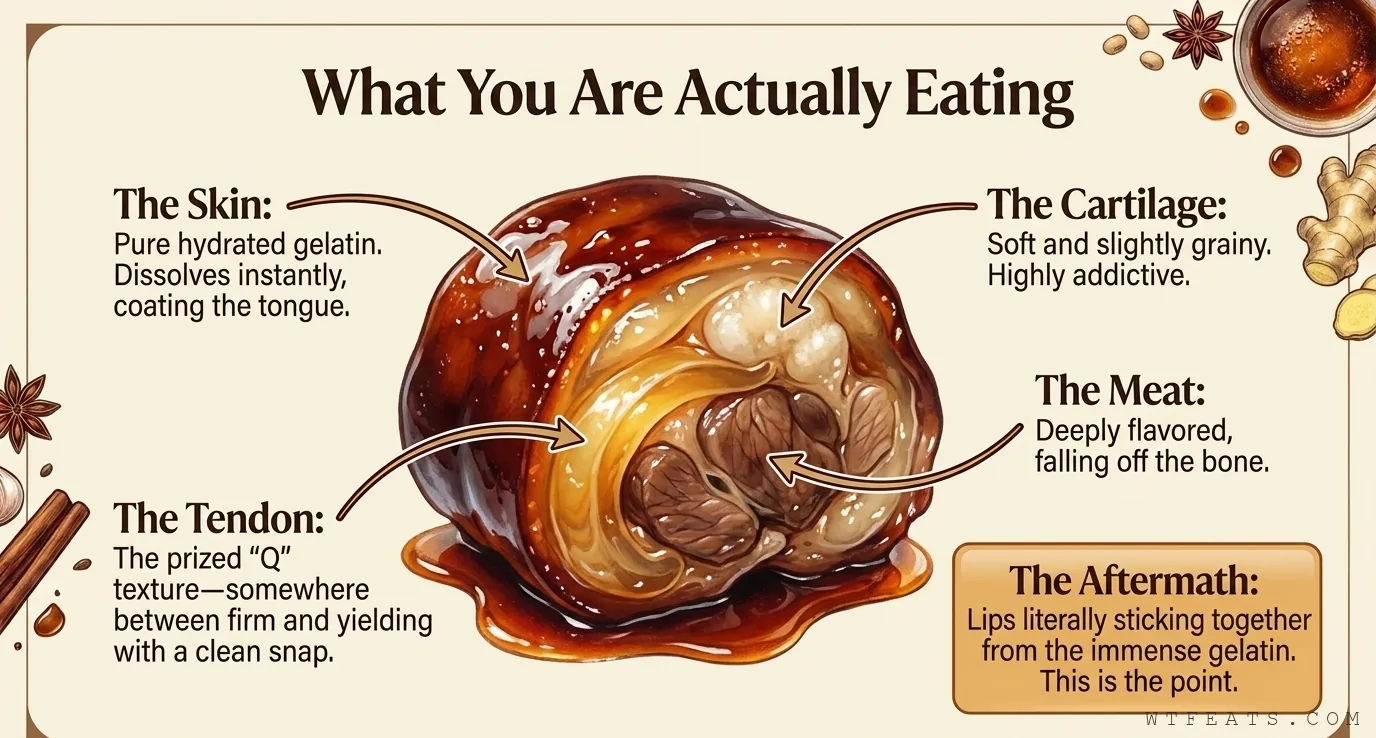
What you are actually eating: skin, tendon, meat, and cartilage cross-section

What you are actually eating.

The skin dissolves almost immediately — pure hydrated gelatin. The tendon gives a slight resistance, then yields: the prized “Q” texture. The knuckle cartilage is soft and faintly grainy — polarizing for first-timers, addictive for everyone else. The meat falls off the bone, infused with six hours of aromatics. And underneath it all, your lips start sticking together. That is not a problem. That is the point.

The Map
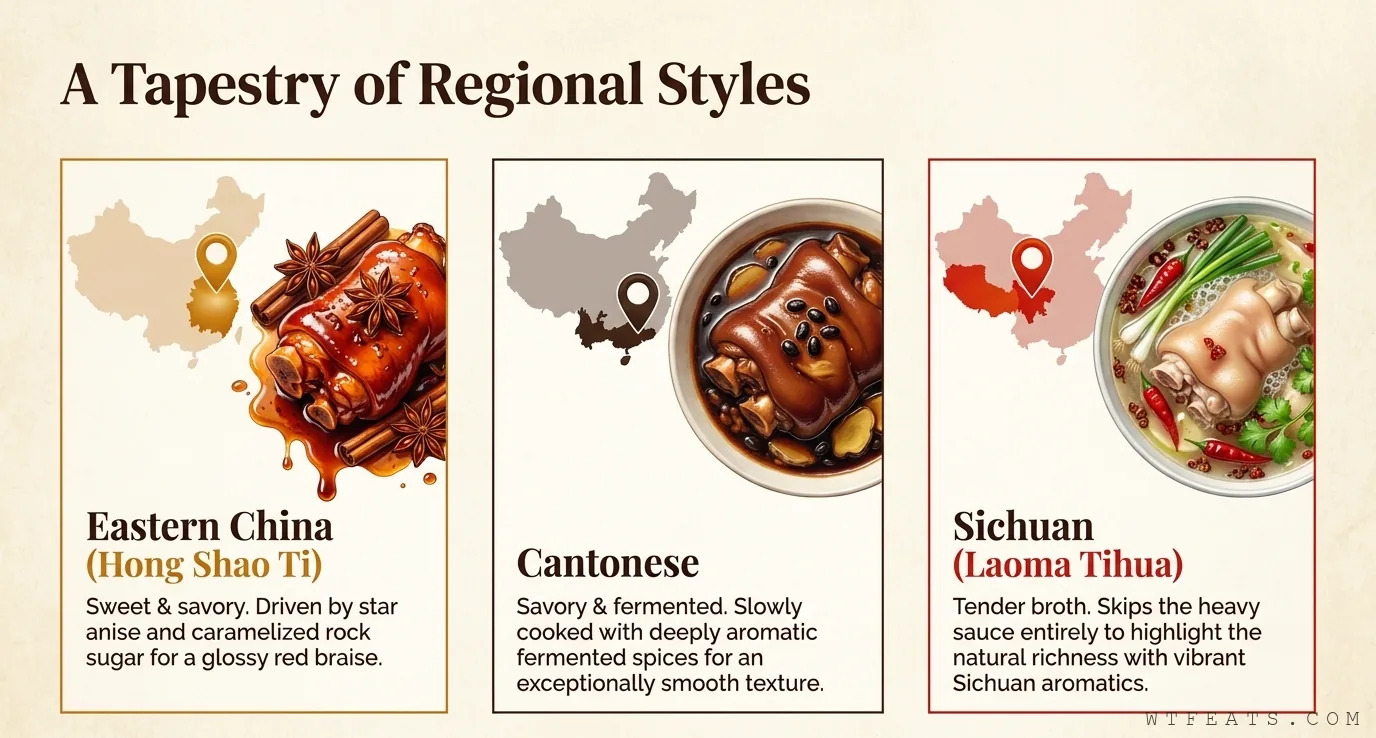
A tapestry of regional styles: Hong Shao Ti, Cantonese braised, and Sichuan Laoma Tihua

A tapestry of regional styles.

Eastern China gives us Hong Shao Ti (红烧猪蹄), the sweet-savory red braise. Cantonese kitchens lean on master stock and fermented aromatics for a deeper, quieter savor. Sichuan answers with Laoma Tihua (老妈蹄花) — a milky, collagen-thick soup where the trotter is so tender it barely holds its own shape.

The Wider World

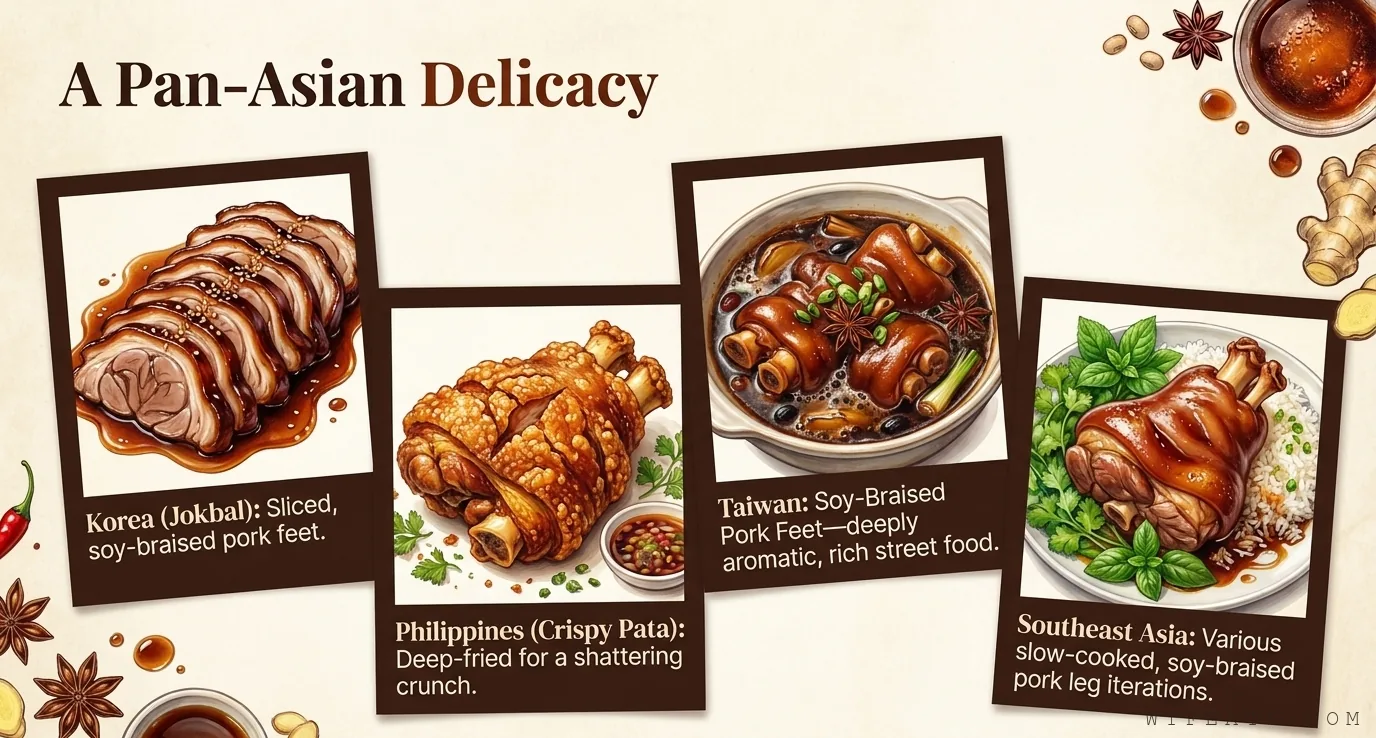
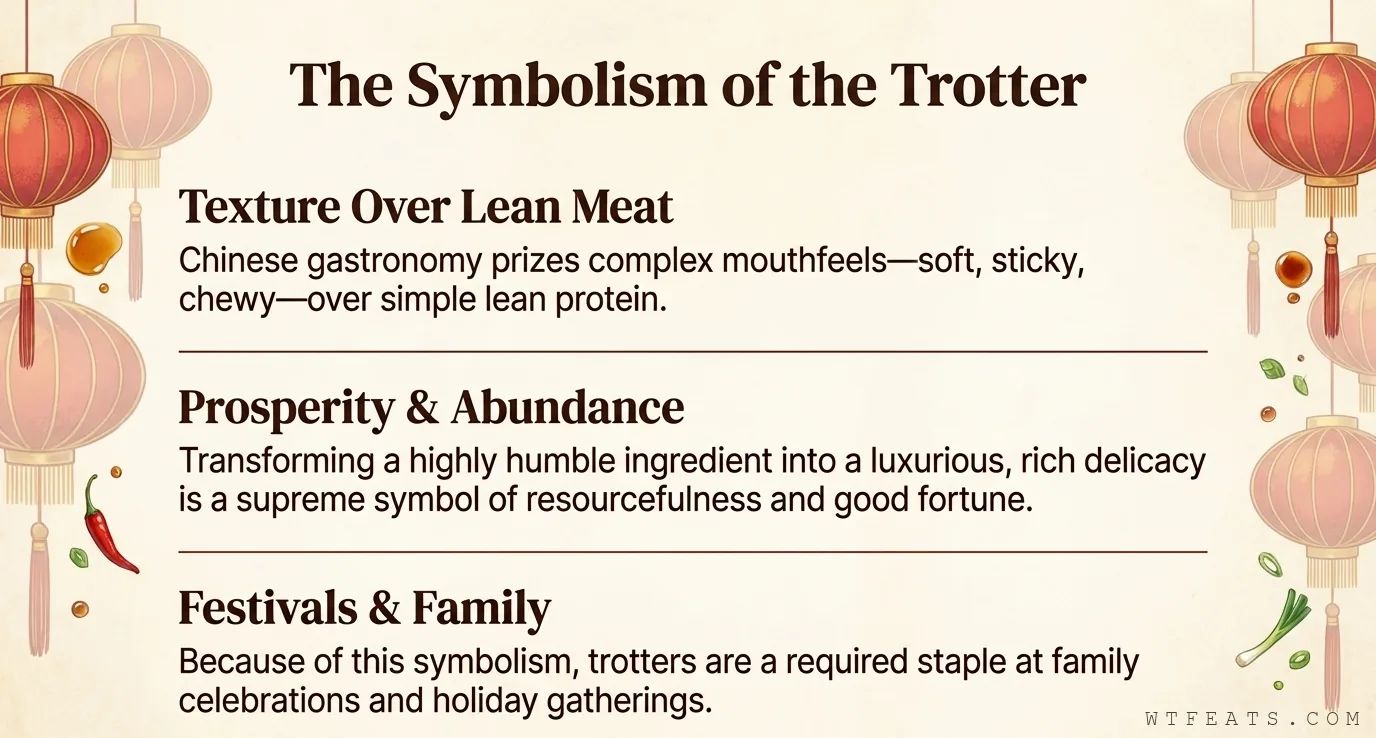
Loved across Asia. Symbolic at home.

Korea slices it into Jokbal (족발) for late-night feasts. Taiwan braises it dark and glossy. The Philippines deep-fries the whole leg into Crispy Pata. And in China the trotter carries meaning: texture valued over lean meat, prosperity on the festival table, abundance at family gatherings. A humble cut, promoted to a symbol.

The Numbers
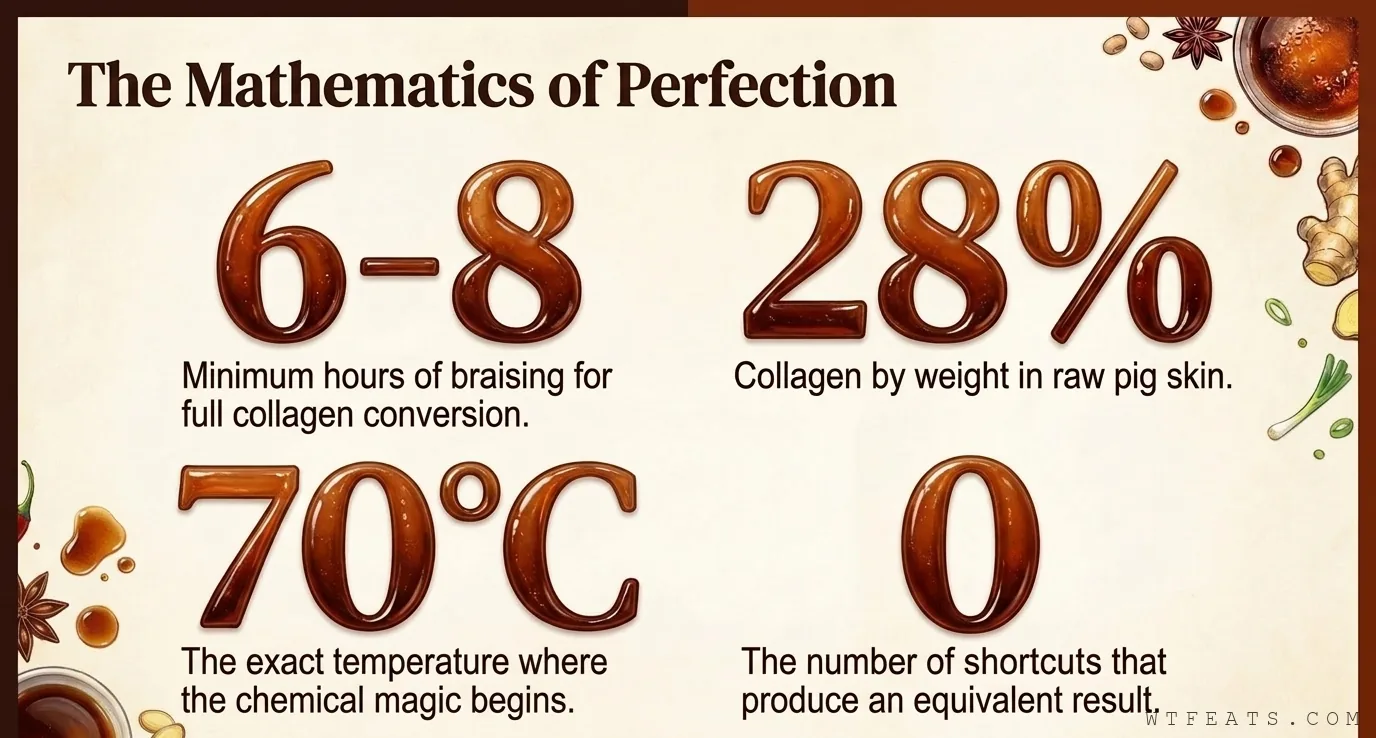
The mathematics of perfection: six to eight hours, 28 percent collagen, 70 degrees, zero shortcuts

The mathematics of perfection.

6–8 hours minimum for full collagen conversion. ~28% collagen by weight in raw pig skin. 70°C — the temperature where collagen starts becoming gelatin. And 0 — the number of shortcuts that produce an equivalent result.

The Final Word
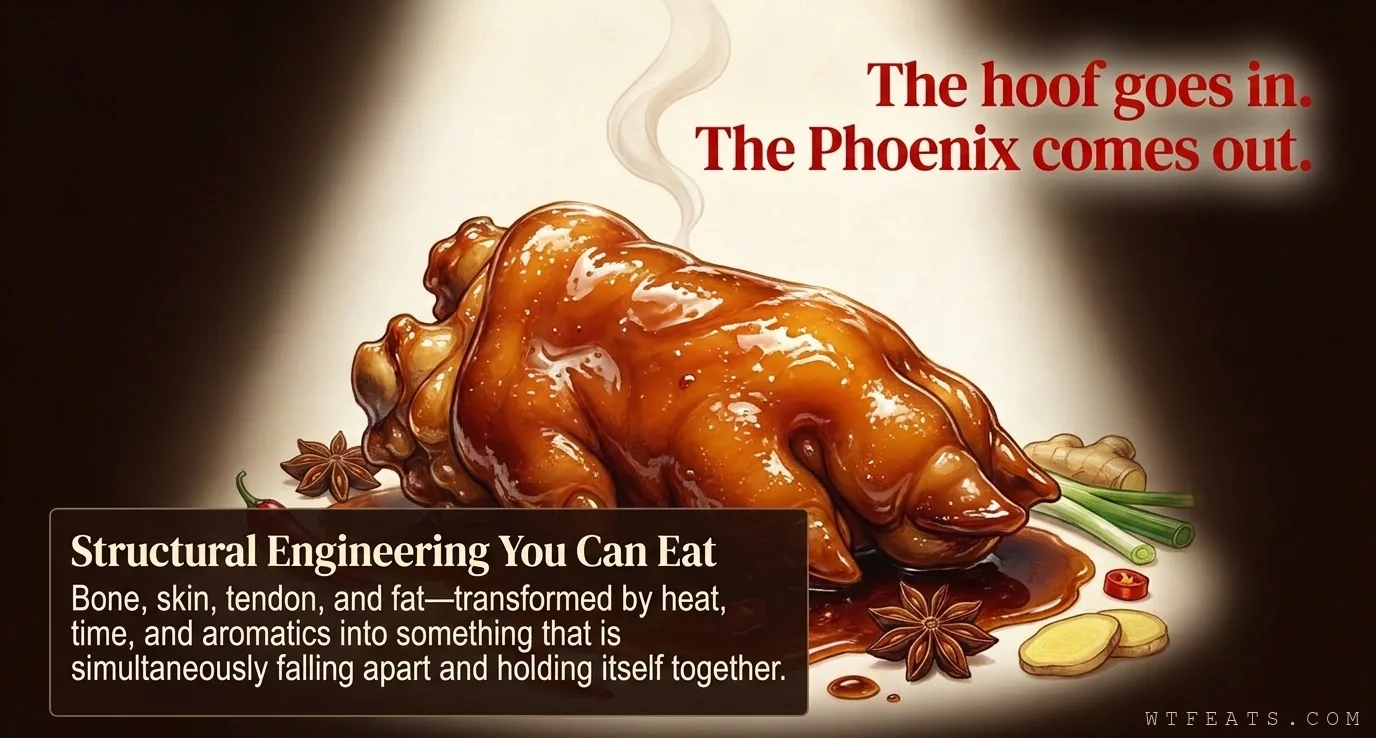
Dark hero shot of a whole braised trotter: the hoof goes in, the Phoenix comes out

The hoof goes in. The Phoenix comes out.

What leaves that pot is a structural engineering project in edible form — bone, skin, tendon, and fat transformed into something simultaneously falling apart and holding itself together. And if that transformation story sounds familiar, it should: our Phoenix Claws pulled the same trick with a much smaller foot. Different animal. Same alchemy.

Read the full craft